
“A union is a great way to meet new people, and argue with them,” writes Hamilton Nolan in his 2024 book The Hammer: Power, Inequality, and the Struggle for the Soul of Labor. Nolan rightfully emphasizes the value of workplace democracy and its many opportunities for constructive argument in building a union movement to fight capitalism.
Books and blogs are also great ways for organizers to interact with lots of people, and argue with them. Democracy, or more accurately in this context, a productive discourse of back and forth, exploration, and experimentation is something the labor movement doesn’t have nearly enough of. Partly this is due to a dearth of good writing about strategy in the labor movement today.
Nolan’s The Hammer and Eric Blanc’s 2025 book We Are the Union: How Worker-to-Worker Organizing is Revitalizing Labor and Winning Big are well-written and carefully argued. In this way they are exactly the kind of books that we need more of to create a culture of informed and healthy debate on the labor left.
Book Synopses
Nolan is a labor journalist who helped unionize his workplace, Gawker, with the Writers Guild of America, East back in 2015. Gawker was the first of a wave of online media companies to unionize in the decade since (including 71 first contracts between 2021-23). The Hammer narrates Nolan’s own union drive and then looks at an array of noteworthy union efforts across the country over the last 20 years. He discusses what made them succeed or fail and why they do or don’t have the potential to scale up further and push the labor movement out of its long decline.

Interspersed with chapters focusing on state- and local-level union efforts are chapters that detail the last 30 years of the history of national AFL-CIO leadership and strategy. He chronicles how occasional attempts at reform have generally been lackluster and how the norm has been to conserve existing unions instead of fighting to advance them or build new ones. This history is told alongside the political journey of Sara Nelson, president of the American Flight Attendants union, who aims to win the presidency of the AFL-CIO in the early 2020s. Her ambition is to reverse labor’s course by going all in on aggressively pushing the movement’s resources into militant organizing campaigns. These stories are told with a journalist’s eye for character detail and a union activist’s feel for charisma and urgency. The book paints a portrait of what the labor movement is today in its diverse forms, how it’s being held back, and why progressives’ quest for top leadership is a big part of the solution.
Blanc’s We Are the Union emerges from a similar political world as Nolan’s The Hammer, insofar as both authors point to Bernie Sanders and the Democratic Socialists of America as key factors in the labor movement. While Blanc’s career has involved much labor journalism, in this book he lays down his reporter’s notepad and assumes the roles of labor sociologist and union strategist.
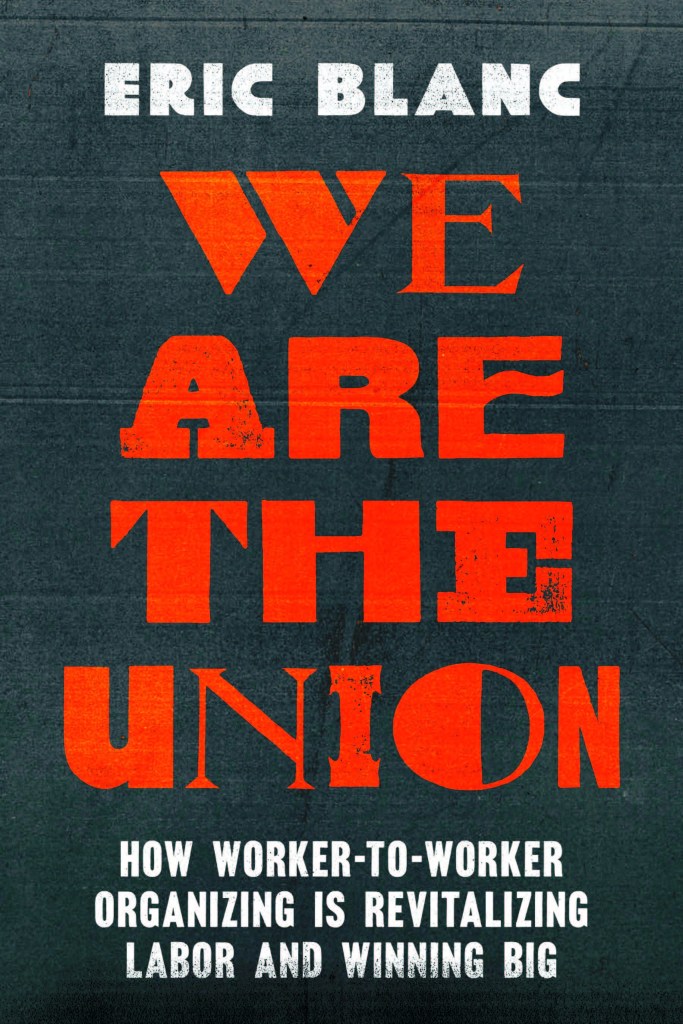
While The Hammer is an overarching story, We Are the Union is structured more as an overarching argument. Blanc’s thesis is that only rank-and-file workers organizing other rank-and-filers directly has the potential to grow to the degree necessary to regain a sizable portion of the working class back into the union movement. Staff organizers today, while good at single-employer unionization campaigns, are too expensive to scale up to organizing tens of millions of workers like was achieved in the 1930s and 40s. Staff still have an important supplementary role to play in boosting and resourcing worker-to-worker organizing, but Blanc is insistent that workers themselves will have to do much that union staff have typically done.
Blanc supports his argument with historical comparisons between unions of the 1930s and those today, with investigations into the changes from a mostly manufacturing economy back then to a mostly service economy today, and with a frank assessment of the worsening legal terrain. While he also looks at a number of recent smaller- and moderate-sized union campaigns as case studies to show the viability of worker-to-worker organizing, the Starbucks Workers Union is the example he leans on the most to prove his point that these methods can be scaled up by orders of magnitude.
Appraisal: The Hammer by Hamilton Nolan
I’ve appreciated some of Nolan’s writings in the past, especially his piece criticizing no-strike clauses (which is also a pet issue of mine):
“The practical effect of no-strike clauses is to produce obedient unions whose real power is confined to brief periods during contract bargaining, and no other time.”
Since Trump re-entered the White House, Nolan has been sounding the alarm at how bad Trump’s anti-union moves have been. In part the labor movement’s response to Trump has been so lackluster precisely because of the no-strike clauses in our union contracts which make it exceedingly difficult for workers to fight for anything beyond wages and benefits.
Based on this passing familiarity with Nolan’s work, I was hoping The Hammer would go deeper into critiquing the deeply ingrained but pacifying structures of the mainstream labor movement and highlighting the need for militant rank-and-file leadership.
But that’s not what this book is. While I agree with much of Nolan’s blistering assessment of the timidity and narrow-mindedness of unions and their leaders today, his main solutions to these problems are a far cry from radical grassroots unionism.
While profiles of rank-and-file union activists are scattered throughout the book and give color to the labor movement tapestry, the true heroes of this book, and by extension the labor movement, are the top union leaders with progressive politics. Sara Nelson is the archetype and is the ideal protagonist for Nolan’s grand narrative.
The stakes of Nelson’s campaign for the presidency of the AFL-CIO are high. Acquiring the nation’s top union position would give her a larger platform to call for a more radical organizing approach. Also, the AFL-CIO and its member unions have lots of money in reserve that has been held back from organizing efforts due to excessive caution and fear of change. As Nolan sees it, a Nelson presidency could unlock both the rhetorical potential of the AFL-CIO as well as its material resources. Doing so would put the labor movement back on a class struggle basis that would lead to a massive union resurgence.
The book follows Nelson’s campaign for president of the AFL-CIO, which is tragically cut short by injuries that Nelson has to spend a long time rehabbing from and then from the onset of covid, which dramatically re-orients the labor movement and freezes Nelson’s campaign ambitions in their tracks. In the end she doesn’t get the chance to run, and longtime union administrator and lobbyist Liz Shuler wins the AFL-CIO presidency.
Despite the repeated references to how Nelson gave the keynote at a DSA national convention and gives a lot of speeches and media interviews, all of which emphasize a left, anti-billionaire politics, it’s difficult to see what particular kind of union organizing theory or methods Nelson really advocates. While Nelson’s backstory is told of her rising from a broke waitress to a flight attendant to a union activist to a union president, nowhere does the book show her leading a union campaign of any kind or training workers on organizing skills or facilitating mass meetings or devising strategy or any of that. She’s more of a passionate voice for militant unionism than an organizer or strategist, which isn’t satisfying for readers looking for fresh ideas and insight about what is needed beyond abstract calls for general strikes and “militancy.”
If not Nelson herself, her associates and other figures in Nolan’s book present various models of unionism. Unite Here local 226 in Las Vegas is a militant union of food and hospitality workers that has to fight for every scrap it can get as it’s up against billionaire casino owners and a Republican-controlled state government. CCPU is a union of childcare workers in California that fights the state for decent wages. Nabisco workers in Portland with the Bakery, Confectionary, Tobacco Workers and Grain Millers union participate in a months-long national strike at the company and successfully defend their wage and healthcare against the extreme cuts proposed by the company. But they also lose their pension plans. The rank-and-filers of these unions are depicted as passionate and committed activists, normal people who took on the fight for a better life and were transformed in the process.
But as the chapters wore on, it was hard not to see the rank-and-file as mere supporting actors behind the supposed brilliance of the national leaders working their magic from center stage. The workers themselves are presented as having the grit and determination to fight back and reach their class power potential, but it’s the national union leadership dynamics where the true fortunes of the labor movement are determined.
This is how most assessments of the labor movement today, from liberals and leftists alike, tend to frame things. The rank-and-file are depicted as strong and capable of fighting employers but are routinely denied the agency and vision to themselves have the potential to directly take hold of the labor movement itself and reverse its fortunes. Rather, what the union movement lacks and desperately needs is strong leaders who can win positions of power within the halls of labor to turn it around.
Emblematic of this politics is the phrasing Nolan uses: “Giving people a union is not giving them a mandatory set of beliefs they must buy into; it is about giving them power.” The idea that workers should be “given” a union and its power instead of the idea that workers should make power, take power, or awaken their power is indicative of a politics that puts workers in the passenger seat.
Aligning with the lack of belief in a rank-and-file led movement is the lack of almost any labor history in the book before the 1970s. The more radical and militant heyday of the IWW and the CIO in the first half of the 20th century is given only passing mention, despite those movements being the only other time in US history when workers achieved what Nolan hopes to see in the labor movement’s future. Detailed histories of the CIO and IWW show how it was primarily the bottom-up organizing that gave those movements their power and breadth rather than their formal union leaders. Putting an exclamation point on his lack of historical sense, Nolan mistakenly calls the IWW the International Workers of the World instead of by its actual name, the Industrial Workers of the World.
My other disagreements with the book are more pedestrian. Nolan places a lot more emphasis on electoralism through the Democratic Party than I find defensible. His hero worship backfires in the case of Teamster President Sean O’Brien, who is given the treatment as progressive union champion in this book but who has since allied with Trump on cabinet picks and endorsed much more moderate union politics (Nolan writes, “Having O’Brien at these [union] events inspires that variety of glee that comes with the realization that the people who look like the bullies are actually on your side.”) His criticisms of capitalism are unsparing, but when it comes to what he thinks we should do with it, he never suggests destroying it but only aims to “keep it tightly controlled.” The lack of critique of the organizational structures of the mainstream labor movement invariably posits bad top leadership as the problem and oversimplistically sets up good top leadership as the solution.
Despite my reservations, I recommend workers read The Hammer for a few reasons. First, it is written by a skilled narrator and is an enjoyable read. Second, union stories and (recent) histories are worth studying and learning from. Lastly, this book presents much of what is the conventional wisdom of the labor left, and thus is a perfect text for critical thinkers to engage with to develop their own thoughts about this orthodoxy.
Appraisal: We Are the Union by Eric Blanc
Blanc’s book is a knockout punch to the argument that unions spending more money on organizing will change the fortunes of the labor movement. Contrary to Nolan’s (and many other commentators’) premise that better union leadership could revive the union movement by spending more money on traditional organizing, Blanc shows how that will never work because it’s too expensive to scale up to the millions of workers needed to actually alter the direction of the labor movement.
In today’s economy, Blanc’s research indicates that it costs on average about $3,000 to pay for union staff to unionize each worker as part of a unionization campaign. For those unions that do actually unionize new members successfully using staff-driven campaign models, they assign about one union staff organizer per 100 workers. Blanc shows how “even were US unions to ambitiously use 30 percent of their [$13.4 billion in] liquid assets on new staff-intensive unionization efforts, this could only get them back to 2015 levels of [membership] strength.” In other words, barely make a dent.
Blanc quotes Jane McAlevey as the foremost authority on and as one of the most successful practitioners of staff-led union campaigns: “We know how to do the work–it’s where the money will come from that’s the immediate challenge. That’s what keeps me up in the middle of the night these days–it’s that I can’t yet sort out how we’ll pay for what I am confident we can actually do.” Even the labor movement’s most headstrong, skilled, and charismatic staffers can’t make the economics work.
What made unionization efforts of the 1930s and 1940s different was that the newly industrialized mass-production industries, like steel, auto, and electronics, were mostly operated through huge workplaces. Workers who worked side-by-side all day in the same factory also lived together in tightly packed working class neighborhoods and all went to the same bars and parks. Due to concentration and proximity, it was just much easier for workers to agitate each other, to talk to each other about problems and solutions, to create a shared culture opposed to capitalism, and to coalesce around the need for union action and organization. Many such union campaigns had very few if any staff, with big union drives by major unions such as United Electrical and the Steel Workers Organizing Committee paying for about one union staff organizer for every 2,000 workers unionized.
Blanc compellingly lays out the challenges we face and steps in to provide the solution. He defines worker-to-worker organizing as having three parts:
“1) Workers have a decisive say on strategy,
and
2) Workers begin organizing before receiving guidance from a parent union,
and/or
3) Workers train and guide other workers in organizing methods.”
In many ways this replicates the model of the 1930s and 40s, but just under the circumstances of a service-based economy and wider dispersion of workers geographically and occupationally.
A big part of what makes this possible is that new technologies in the form of virtual meetings and social media can replicate some aspects of working class communication and proximity that existed in the 1930s and 40s. Even if Starbucks workers are geographically scattered around and you could rarely ever get more than a few dozen in the same room at the same time, you can reach tens of thousands of them through targeted social media and get hundreds of them on a Zoom call together.
Blanc still reserves an important supplementary role for union staff who, not unlike a century before, can provide organizational resources and expertise. The aim is not for staff to lead the campaign (that’s too expensive) but to offer counsel, infrastructure, tools, and support.
When I began reading We Are the Union I had anticipated not particularly liking it, as I didn’t Blanc’s earlier book Red State Revolt about the state-wide educator strikes in 2018. That account struck me as lacking critical analysis of the political or economic dimensions of the movement, providing an oversimplified narrative of the events, and over-attributing the meaning and power of the movement to Bernie Sanders.
But to my delightful surprise, I found We Are the Union to contain well-evidenced and forceful arguments, insightful commentary on competing union strategies and theories, and an inspiring belief in rank-and-file workers to take the lead in pushing the labor movement out of its muddy ditch. This last part is of particular emphasis for me, as so few labor writers really trust rank-and-file workers to have what it takes to tackle the most daunting challenges and overcome the most imposing obstacles of our historical moment. As he states near the end, “A beautiful thing about these kinds of bottom-up labor struggles is that they put the lie to our society’s contempt for the intelligence of working people.” I attribute my own belief in “normal” workers to my own union organizing experience as a rank-and-filer. I see my coworkers again and again break out of the smaller roles that the union movement has allotted to them and often achieve more than their union leaders even attempted to.
The most fascinating example of worker-to-worker organizing that Blanc discusses is the NewsGuild. The NewsGuild up til the mid-2010s ran traditional staff-driven organizing campaigns, but over the course of the next decade totally revamped the union’s organizing infrastructure to tap into the more bottom-up union energy they saw bubbling up all around. Central to this has been the Guild’s Member Organizer Program, which staff organizer Stephanie Basile set up with the basic idea that “workers are capable of learning how to do everything a staff organizer knows and does.” Amen.
Basile would bring recently unionized worker leaders with her to help spawn and support new union drives, worker leaders themselves led trainings for other workers in their industry across the country, a system of pods was set up clustering workers in groups of 10-12 from different industries and geographies to meet monthly and share organizing stories and troubleshoot organizing problems together, and a national worker-to-worker mentor mentorship program was implemented. Blanc observes, “Effectively distributing responsibilities downwards has obliged the Guild to develop more extensive training materials and organizing support than I’ve seen in any other union.”
Despite my overall agreement with the book and my strong recommendation that others read it, I still have plenty of small bones to pick. While I agree giving union staff a supplementary role in union campaigns is more economically feasible and opens up new political possibilities and organizing tactics, this can also be pushed to its ultimate conclusion of abolishing union staff altogether.
I don’t think this should be done overnight. But given the amazing grassroots organizing infrastructure that the NewsGuild built, it’s not too hard to imagine that a series of next steps over the course of five more years could lead to that infrastructure being entirely run by the rank-and-file.
Instead of NewsGuild workers paying for staff to be the experts to go to when needed, workers themselves acquire all of the necessary expertise themselves over the course of years and decades of personal experience and training. Rather than worker dues going to full-time union staff being the only ones with capacity to do some of the heavier lifting, what if the dues paid for some of the rank-and-file to be given 25% time off their job to run the Member Organizer Program and/or were sent on short-term assignments around the country to support union campaigns (while the organizing side of unions can be replaced by worker-run models, I still think unions should hire full-time staff to handle other organizational functions like accounting and clerical work).
Worker-run models have the benefit of keeping union campaigns entirely in the hands of the rank-and-file who still spend most of their lives at work in the industries they are organizing in, thus preventing specialized layers of paid staff or leadership from developing their own interests apart from the rank-and-file. I know this is a rather lofty and longer-term goal, but I don’t see any good reason not to set our sights high. Blanc’s book has the great merit of showcasing what such principles look like when implemented half-way.
My main political disagreement with Blanc is over the relationship of the union movement to electoral politics and labor law. Blanc has weighed in on long-standing scholarly debates on these questions and has in recent years become the most vocal exponent of the view that electoral politics and union militancy should go hand in hand. “Though unions shouldn’t subordinate themselves to politicians or depend on legal reforms to win, the experience of labor’s uptick since 2020 shows that electoral politics and policy reforms can help workers win widely.”
Blanc is here objecting to the “neo-syndicalist” stance of Michael Goldfield. Goldfield argues that rank-and-file militancy alone, independent of the initiative and willingness of politicians, has been the root cause of all positive labor reforms and victories, including the eight-hour day and the right to join a union. I side with Goldfield on the general issue of anti-electoralism in social movements, though I think there is a much stronger version of the particular historical argument about labor law reform to be made than Goldfield has articulated. If I ever find the time, I hope to one day engage Blanc’s writings directly on this issue and make a much more forceful case for the overwhelming primacy of rank-and-file agency.
Cadre is Key
Intimately related to the question of rank-and-file agency, from a different angle, is the role of socialist cadre within the labor movement. By socialist cadre, I mean those socialists who are in socialist organizations (aka “cadre orgs”), who have very high levels of commitment to and capacity for organizing, and who through their organizations engage in political study, skills-honing, and developing a unified strategy for engaging social movements.
Nolan seems almost unaware of the role of such cadre as rank-and-file in past and present labor movements, which I think partly explains why he is so reluctant to see the movement-altering potential of a radical layer of rank-and-file. We Are the Union discusses cadre obliquely in a few spots, and surely Blanc has a historical knowledge that would ensure his awareness of the importance of cadre to past movements.
That so few contemporary labor writers have theorized or strategized about the potential role for cadre in re-energizing today’s labor movement has been a debilitating oversight. My comments on cadre below constitute more of an indirect critique of Blanc and more of a way for me to set up my own thoughts. If I misattribute ideas to Blanc that are at best faintly sketched in We Are the Union, I would love to see his (and anyone else’s) more fleshed out thoughts on the matter.
Blanc implicitly creates some false binaries which obscure what’s necessary to truly revive the labor movement. First, rather than exploring the role of cadre in labor movement resurgence, Blanc chooses to survey worker organizers on what non-labor influences inspired them to get involved in the labor movement in the first place. Black Lives Matter, Bernie Sanders, and LGBTQ politics are the most commonly cited. Certainly the Sanders campaigns and the Democratic Socialists of America have been important aspects of the socialism landscape over the last decade and brought many people into contact with socialist politics, but by themselves these phenomena have very little to do with cadre.
While I think this focus on getting initially involved in the labor movement is one key aspect, Blanc misses the more important second half of the story where people who are merely involved then develop into lifelong devotees of class struggle (aka, cadre). In fact, some unionists in cadre orgs have been pivotal to the exact union campaigns that Blanc discusses, but for the purposes of his book it seems he doesn’t see fit to explore this.
Secondly, empowering masses of workers to get involved in the labor movement (building and developing unions), which is the main subject of We Are the Union, is on the surface a different task from turning workers into self-conscious agents of class struggle (building and developing cadre).
But for today’s unionists there is a danger in implicitly separating out the tasks of building unions and building cadre. The main bottleneck in achieving a stronger labor movement is not bringing broad swathes of workers into large-scale fights, which periodic strike waves and other class struggle moments effectively accomplish. Rather, the main bottleneck is the number of rank-and-file cadre available to anchor class struggle to broader working class communities and who can develop bottom-up institutions capable of coordinating and empowering huge masses of worker-leaders for the long-term.
Every single successful labor movement upsurge of the past that aimed to embrace the working class as a whole, instead of some smaller subsection of skilled workers, was led and sustained by a layer of rank-and-file cadre. Prototypical examples include the Communist Party in the militant CIO unions of the 1930s and 40s such as the ILWU, UE, and the early UAW, and the Communist League in the Minneapolis and Midwestern Teamsters. The IWW, past and present, lacks some features of cadre organization, such as being tightly unified strategically, but exhibits other such features as attracting and cohering revolutionary unionists with high levels of commitment.
In other words: no cadre, no renewed labor movement. In my own organizing experience in unions, people of all political and organizational persuasions get involved in and even occasionally lead fights against the employer when working conditions get bad and the boss becomes a clear enemy. But it’s only the committed socialists of various stripes who come back into the fight year after year after year to build out the networks of class conscious organizers needed to grow the movement in the face of hostile and constantly changing social conditions.
Blanc discusses the Emergency Workers Organizing Committee (EWOC), which solicits calls from workers interested in organizing at their job. EWOC is volunteer-run and supports workers in getting the basic skills and support systems in place to get their organizing off the ground in the form of an active workplace committee. If the workers successfully build such a nucleus, the next step usually involves connecting with a more established union to expand the fight to larger fights and likely a unionization campaign.
EWOC is a great outreach tool and starter kit for the labor movement, fanning countless little embers of worker organizers trying to get their fire going. But for those flames to expand and coalesce into a real inferno amid the downpour of capitalism and ascending fascism, we’re gonna need more than twigs and dry leaves. We’ll need logs and gasoline. Only cadre can provide that.
In my incomplete understanding of recent cadre development in the US, the first decade of the 2000s were mostly a wasteland of cadre organization, with only a few around and small in size. The Great Recession and subsequent social movements re-initiated a long and gradual process of cadre development in the US. Over the last 15 years the number of and maturity of cadre orgs has steadily grown. LeftRoots was the org that most publicly theorized cadre-fication in the 2010s. The number of politically cohered and growing caucuses in the Democratic Socialists of America is an example of this broader process of maturation. National-level cadre-like and cadre-aspiring organizations like Black Rose and the many cadre seeds scattered by the collapse of the International Socialist Organization are complemented by many more local and regional orgs.
To be sure, none of these cadre orgs have reached near the level of development in either number of members or development of politics and organization that Communist Party in the US in the 1920s and 30s. But things are going in the right direction, and maybe there’s some value in a more distributed cadre org ecosystem if collaboration and constructive differentiation can overcome sectarianism. Whatever form it takes, only a flood of new cadre has the potential to lift the labor movement over the banks of capitalism.
Conclusion
Creating rank-and-file cadre is the deepest dimension of organizing that there is because it’s that layer of rank-and-file that can be the long-term connective tissue between radical politics, militant tactics, and a broad base of working class participation. In contrast, the shallowest kind of organizing is a narrow focus only on “union density,” only caring about how many members are “in” a union while ignoring the strength and character of those unions. While union density can be one useful heuristic for loosely measuring the strength of the labor movement, as a goal union density is misguided and as a benchmark for organizing it is misleading. Higher union density is the effect of a powerful labor movement, not its cause.
When so many contemporary labor commentators declare, as Nolan does in The Hammer, that “The only thing that matters is turning around the crushing descent of union density,” I’m afraid that they are mistaking what union power really is and where it comes from. Blanc is correct to fixate not on density but on the scalability of effective organizing models.
One of the most successful cadre-run, scaled-up campaigns in US labor history was the unionization of interstate truckers with the Teamsters in the late 1930s. A few years prior trucker Ferrell Dobbs cut his teeth as a militant in the historic 1934 Minneapolis truckers strike as part of a cadre of rank-and-filers with the Trotskist Communist League of America (after the 1934 strike Dobbs became a union staff organizer, whose role in the interstate trucking campaign could in many ways be compared to the “lightly”-staffed model advocated by Blanc).
After consolidating the Teamsters local after the 1934 strike, Dobbs and other Teamsters saw the potential and strategic position of trucking in the wider region as prime for further organizing. They first unionized the long-haul trucking firms based out of Minneapolis in 1937, and then proceeded to systematically expand their organizing infrastructure outward geographically. A series of pitched battles is recounted dramatically in Dobbs’ book Teamster Power, including strikes and lockouts at particular firms, mass arrests for defying state laws that practically banned pickets, and brawls with anti-union thugs.
In late 1938 the Teamsters signed a first contract covering 125,000 truckers across a region extending West to the Dakotas, East to Ohio, South to Missouri, and North to Minnesota, and covering 1,700 trucking companies. A year later they signed a second and even wider contract affecting 200,000 workers, expanding to include twelve total states by adding Nebraska, and 2,500 companies. (Both contracts successfully excluded no-strike clauses of the kind common today; the contracts empowered workers to withhold their labor during the life of their contracts if grievances couldn’t be settled through negotiations with management).
This was the key campaign that spawned further organizing drives and eventually led to the Teamsters becoming the largest union in the country for a time. This is the scale and aggressiveness of union campaign that Blanc, Nolan, myself, and so many others dream of seeing in today’s labor movement. Sadly, throughout the 1940s the radical Teamsters were aggressively attacked and repressed by a combination of national politicians, the FBI, federal courts, industrial associations, and union bureaucrats. By the 1950s, the militant edge of the Teamsters had been drastically pulled back.
This campaign is suggestive of some of the questions to consider about scaled-up union campaigns. Did the interstate trucking campaign privilege surface-level membership numbers over deeper political education and cadre organization? Historian Brian Palmer writes in his 2013 book Revolutionary Teamsters:
“Rather than utilising ongoing struggles to build militant class-struggle caucuses in the distant locales where interstate organising campaigns were being launched, the Minneapolis trade-union leaders [led by Dobbs] tended, instead, to forge relationships with established IBT union leaderships. This was the easiest path to follow, and it produced tangible short-term gains. The result, however, was that a rank-and-file, infused with radical currents, … did not cohere as it had in Minneapolis in 1934. This was the only force that could actually serve as an effective brake on the anti-communism and conservatism inherent in the mainstream trade-union bureaucracy…”
Wherever labor organizing becomes disconnected from rank-and-file cadre development, the stage is set for eventual bureaucratization and deradicalization. Even in the largest and most militant campaigns like the Midwestern truckers campaign of the 1930s, these processes must not be separated. If either Nolan’s dream of a newly militant AFL-CIO leadership that funded new organizing or Blanc’s dream of a worker-to-worker organizing explosion were to come true, its long-term viability would depend on the quantity and quality of its cadre.
Today’s radical workers would benefit from sharpening their critical thinking on the grindstones of experienced organizers and talented writers like Blanc and Nolan. At its best, such discourse expands our political horizons and narrows our strategic focus. The task is left to our newest generation of emerging cadre to test and refine these union ideas–and then to supersede them.
 Fire with Fire
Hello again! I find this take on cadre development very interesting. I’d like to have a manual on building strong cadres. In simpler terms, are cadre the shock troops? In other words union fanatics who can take a licking and keep on ticking? How do cadres become bigger cadres? Labor Notes has the bullseye method for determining support in Secrets of a Successful Organizer (SOASE). Organizing 4 Power has structure tests to gauge commitment and talks of organizers and organic leaders. At what point does a member become cadre? What are the tests of a cadre to measure its level of cadre? I want more nuts and bolts so we can start building them because we’re running out of time on climate disaster and nuclear bomb threat, WWIII, collapse of the labor movement, etc. Really well done!
LikeLiked by 1 person
Hey again! Cadre is kind of a loose term that gets used in different ways, but the basic definition I use above is just a member of a socialist organization that has a higher degree of political and strategic unity and a higher level of personal commitment. There’s definitely many different ways such orgs can operate and look. What’s distinct about cadre from your other passionate union activists is that cadre are, in addition to union members, also part of a separate socialist org that is doing a higher degree of internal political education and strategy development. LeftRoots has a lot of writing on what they think cadre should be, and while I politically disagree with a lot of their stuff, I find their organizational ideas very stimulating. The Romance of American Communism is a bunch of mini-profiles of former members of the Communist Party USA, and is another look at what it meant to be cadre. Generally though, I think the subject is not as much discussed on the left as it should be.
LikeLike
i am truly grateful.for your responses. You are a leading voice and subject matter expert. I need your advice on something. I work in government and they are firing my colleagues left, right, and center. My Union Local is tiny and our management has shut us out of negotiations. Turns out the president is resigning. She has a lot of fire and is a great toe to.toe fighter. They just piled work on her to knock her out. Im the president of last resort. What principles are most important for building a fighting Union in hard times. Our Union has overrelied on mobilization at best and legal wins under Biden. We are facing down a big A level boss fight and we are NOT ready. I dont want to become Old Joe the Union Prez who just sits his thumbs.
LikeLiked by 1 person
I’m sorry to hear your local is in such disarray and being targeted in that way! I can only really give the most general of comments without knowing the details about your situation, but I think it’s ok not to take on too big a role for yourself if it doesn’t feel sustainable. Trying to stay in close conversation with your coworkers and what they want and need is I think the most important thing, and if you becoming president helps with being in close communication and coordination with coworkers, then great. But if not, I think not taking on a big role like president is totally fine too. My department has been under fire the last few months too, and while I put a lot of work into fighting back, I also have had to try to pull back my activity to keep from burning out. Anyway, good luck with your fight.
LikeLike