A color quilt of diamond shapes that converge in the middle of the image like a star. The colors produce concentric circles of mostly reds, pinks, and yellows.

So You Want to Organize with the Union Movement?: How to Get Started

[A pamphlet version of this post is available for download here.]

Recent cycles of crisis and protest have created an ever-growing number of radicalized youth and young adults. While there’s been wide variation in social movement activity year by year, since 2011 there’s been a significant upsurge.

As initial phases of intense agitation and involvement pass, many young people think about how to turn their change in political consciousness to a change in their life. The crests of heightened action are too intense emotionally to sustain indefinitely, and the troughs of demobilization are too long for a committed protestor to remain perpetually engaged.

The union movement is one place where you can build towards long-term radical change as part of a sustainable, consistent, and long-term commitment. Almost everyone who isn’t already rich has to work for a living. If that includes you, there’s a lot of people you can unite with against those few who profit off your labor.

Continue reading

A creamy white fabric is covered with a winding series of small flowers, leaves, stems growing from left to right. The design is colored in brown.

“Don’t run for executive board”: How to Take Over Your Union from the Bottom Up

[This post is part of my series on union organizational structures.]

Many workers today find themselves asking, “If unions in general are good, why does my union suck?” The member meetings are unbearably tedious, abuses and unsavory conditions are widespread at work, wages keep falling against inflation, health insurance premiums keep going up, and, worst of all, none of the union’s initiatives or campaigns seem to be helping. 

For many workers who are dissatisfied with their union, taking over the executive board appears like the logical way to make their unions better. They think that the union itself is a good thing and all that needs to be done is replace the bad leadership with good leadership. As common as this mindset is among union activists, it ignores a deeper and structural critique of why today’s unions are so dissatisfying in the first place. More often than not, such efforts to win union leadership end up perpetuating the very structures that are responsible for the dissatisfaction in the first place.

Unions have different structures and dimensions that are worth teasing apart and evaluating separately. What’s good about the union is the bringing together of workers to fight for better a better life. At its core, the union is democratic because workers are taken together as all having equal standing and voice. The union is militant because it’s based on workers taking action together. The union is radical because workers deciding and acting together in their own interests sets them apart from and against the overarching economic structures of society wherein workers merely exist to be squeezed by investors for profits.

Continue reading
The image is of the ruins of an old city, with dark yellow stone walls and pillars on a hillside. All of the buildings have long crumbled away. The image is of Jerash, a city in Jordan that dates back to 7,000 BCE.

Helping Coworkers Overcome Ambivalence Towards Change (Listening Series, Part 3)

[Parts 1 and 2. These posts on listening are part of my larger series of posts on relationship-based organizing.]

In the previous post, I used the example of Connor being ambivalent about standing up to his boss Bill to illustrate how to use the general listening tactics OARS (open-ended questions, affirmations, reflections, summaries) to build trust and strengthen the relationship. While building trust is one essential ingredient, in the counseling approach of Motivational Interviewing (MI) there’s an additional set of practices that are used to help people get past ambivalence and that can be applied to specific such organizing situations. While these are not essential organizing tools that every organizer should know and practice (like AEIOU), I nonetheless have found them helpful in talking with those coworkers who seem stuck.

The goal of these methods is evoking the will to change that people already have inside of them, tapping those enormous reserves of motivational energy that everyone possesses but can be suppressed by ambivalence. The main way to do this is to support people in expressing their values, interests, abilities, and aims out loud. “In particular this process occurs in MI by literally talking oneself into change. People tend to become more committed to what they hear themselves saying.” 

Continue reading

Self-Acceptance in Organizing (Listening Series, Part 1)

[This series on listening is part of my larger series of posts on relationship-based organizing.]

Everything that is democratic, caring, and collaborative in human relationships is created through listening. Thus for the relationship-based organizing model that I advocate on this blog, listening is at the foundation of everything. 

And yet, good listening is not easy. Good listening can appear instinctual, unique to each personality, and situation-dependent, all of which make it hard to analyze and strategize about in a way that organizers might find helpful.

I entered adulthood as a bad listener. I wasn’t the kind of person who would talk too much so as to edge other people out of talking, and I listened plenty and asked people questions to evoke their thoughts. But for me the quality, not the quantity, of my listening was what was bad. I didn’t know good listening was a thing, so I just assumed that all listening was more-or-less the same. 

My first lesson in good listening was just noticing that some of my friends were good at listening to me. Being listened to made me feel seen and whole, and that was something I wanted to give back to my friends.

Continue reading

Not My Union: The Workplace Politics of Stan Weir and Martin Glaberman

[This post is part of a series on relationship-based organizing.]

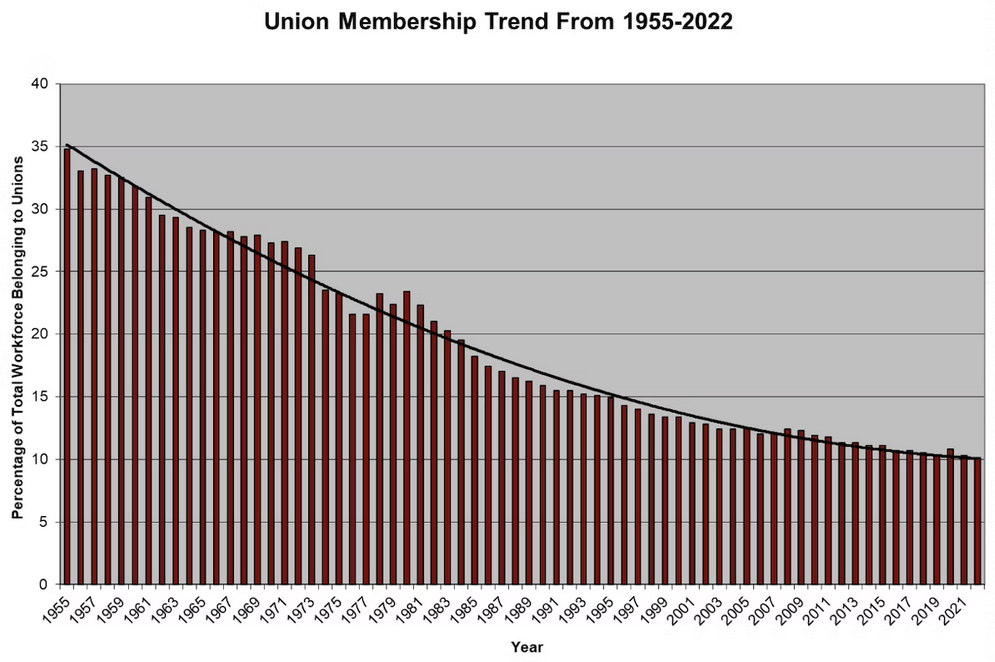
Despite an increase in buzz and news stories about labor organizing in recent years, actual union membership in the US is continuing its long decline. The most recent statistics show a 10.1% union density in 2022, the lowest on record. 

The image is of a graph of union density in the US from 1955 to 2022, showing a steady downward slope from 35% density in 1955 to 10% density today.
Source.

All of the respectable ideas for fixing this problem have been tried and failed. On the fringes of the official labor movement is an idea that doesn’t get much airtime but might have the ingredients of an effective solution: To save the labor movement we have to abandon the Union movement. 

I capitalize the U in union deliberately to designate the form of union that has become historically dominant in the US. Such Unions include all of the big-name ones in the AFL-CIO and all of the other prominent unions in the US today. Such Unions have two distinguishing features. First, they contain no-strike clauses that prohibit workers from withholding their labor for the duration of the union contract. Second, they contain management rights clauses that take away union voice and influence from workers over job conditions and that declare management alone has the “right to manage” the workplace. Together, these Union clauses amount to telling workers to shut up and get back to work, something workers now hear as much from their Union reps as from their bosses.

Two worker radicals and writers who posed a different vision of unionism were Stan Weir and Martin Glaberman, authors of, respectively, Singlejack Solidarity (2004) and Punching Out & Other Writings (2002) (out of print and expensive to buy used, but downloadable as a pdf). Both books are collections of the authors’ shorter writings and were published shortly after their authors’ deaths. 

Continue reading