Nolan’s The Hammer, Blanc’s We Are the Union, and the Question of Rank-and-File Leadership

“A union is a great way to meet new people, and argue with them,” writes Hamilton Nolan in his 2024 book The Hammer: Power, Inequality, and the Struggle for the Soul of Labor. Nolan rightfully emphasizes the value of workplace democracy and its many opportunities for constructive argument in building a union movement to fight capitalism.

Books and blogs are also great ways for organizers to interact with lots of people, and argue with them. Democracy, or more accurately in this context, a productive discourse of back and forth, exploration, and experimentation is something the labor movement doesn’t have nearly enough of. Partly this is due to a dearth of good writing about strategy in the labor movement today.

Nolan’s The Hammer and Eric Blanc’s 2025 book We Are the Union: How Worker-to-Worker Organizing is Revitalizing Labor and Winning Big are well-written and carefully argued. In this way they are exactly the kind of books that we need more of to create a culture of informed and healthy debate on the labor left.

Continue reading

Critical Book Review: Power, Manipulation, and Burnout in Pitkin’s On the Line

On the Line: Two Women’s Epic Fight to Build a Union (2022) by Daisy Pitkin is probably the most well-written book about the labor movement I’ve ever read. The book is an account of the author’s experience as a union organizer in the mid-2000s written as a long letter to the worker organizer she developed a close bond with, Alma. The characters are relatable, passionate, courageous, and draw you in. The author’s first-person organizing stories are interwoven with important union history to astutely draw out themes of labor struggle as true of capitalism of years past as they are today. An allegory of the moth’s desire to fly towards the light of a fire and to its own certain death illustrates the drive union organizers have to keep fighting bosses despite the self-destructive effects these fights have on their mental and social lives. If you like well-written books, you should read this book on these merits.

If you are looking for any kind of inspiration or positive model for what union organizing can be like, you should read a different book. On most pages Pitkin has a caring voice as a writer and a gentle touch as an organizer, but gentleness by itself is no protection from the machinations of personal and institutional power that subtly slice through the chapters. You almost forget how unseemly an image of union organizing this is because the storytelling is by turns electrifying, stirring, and heart-tugging. I’ll leave it to other reviewers to discuss the book’s positive aspects, and I’ll confine myself to the political message and meaning of the story for workers and organizers today.

Continue reading

Not My Union: The Workplace Politics of Stan Weir and Martin Glaberman

[This post is part of a series on relationship-based organizing.]

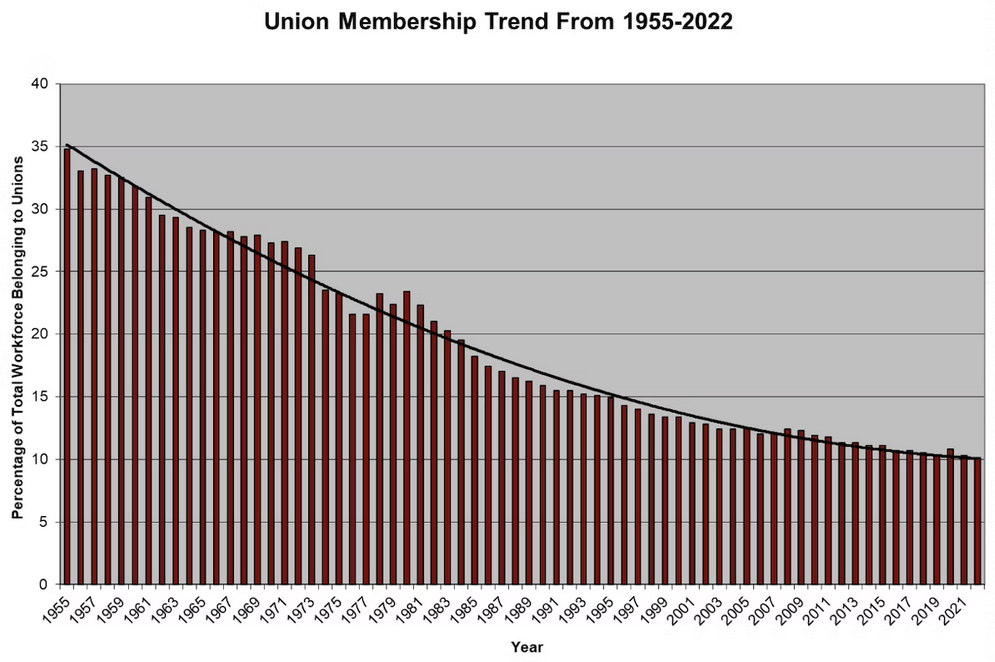
Despite an increase in buzz and news stories about labor organizing in recent years, actual union membership in the US is continuing its long decline. The most recent statistics show a 10.1% union density in 2022, the lowest on record. 

The image is of a graph of union density in the US from 1955 to 2022, showing a steady downward slope from 35% density in 1955 to 10% density today.
Source.

All of the respectable ideas for fixing this problem have been tried and failed. On the fringes of the official labor movement is an idea that doesn’t get much airtime but might have the ingredients of an effective solution: To save the labor movement we have to abandon the Union movement. 

I capitalize the U in union deliberately to designate the form of union that has become historically dominant in the US. Such Unions include all of the big-name ones in the AFL-CIO and all of the other prominent unions in the US today. Such Unions have two distinguishing features. First, they contain no-strike clauses that prohibit workers from withholding their labor for the duration of the union contract. Second, they contain management rights clauses that take away union voice and influence from workers over job conditions and that declare management alone has the “right to manage” the workplace. Together, these Union clauses amount to telling workers to shut up and get back to work, something workers now hear as much from their Union reps as from their bosses.

Two worker radicals and writers who posed a different vision of unionism were Stan Weir and Martin Glaberman, authors of, respectively, Singlejack Solidarity (2004) and Punching Out & Other Writings (2002) (out of print and expensive to buy used, but downloadable as a pdf). Both books are collections of the authors’ shorter writings and were published shortly after their authors’ deaths. 

Continue reading

The Contradictions of Paid Staff in the Union Movement, Part III

[This post is part of my series on union organizational structures. See also Parts I and II.]

A few years ago I was solicited to apply for a staff job in the union I’m a member of and was told that if I applied I’d likely get it. On the one hand, this was a bit of an ego boost to know that I was respected enough for my organizing to get this kind of invitation. Without the job title and the status of being a “professional” organizer that comes with being paid for it, society views your efforts as less serious and merely recreational.

I also knew that if I got the organizer job that my annual income would nearly double. That certainly was appealing in some ways, but it’s not what my politics and beliefs suggested was the best way to build the union movement and create the wider social change that I sought. Being in a position where I didn’t have large financial obligations like lots of debt or needing to be a breadwinner for a family, I could turn down such a salary and stay true to my vision of change. 

Continue reading

The Contradictions of Paid Staff in the Union Movement, Part II

[This article was originally written for the Industrial Worker and is part of my series on union organizational structures.]

Staff Organizers vs. Worker Organizers

How staff organizers navigate the contradictions of capitalist unionism, as detailed in Part I, informs how they differ from and interact with worker organizers.

When staff members are sincerely trying to nurture worker power, they build relationships with workers and support them as they navigate organizing in the workplace. However, the relationship between the worker and staffer is inherently supplemental and not the source itself of worker power, as the relationship between the staff and worker isn’t based in the workplace itself. The staff and the worker don’t together take action by withholding their labor or implementing workplace policy through their own control of their collective labor in the workplace. The staff stands outside of the workplace, while workers build and exercise power with each other in the workplace.

Continue reading