Critical Book Review: Power, Manipulation, and Burnout in Pitkin’s On the Line

On the Line: Two Women’s Epic Fight to Build a Union (2022) by Daisy Pitkin is probably the most well-written book about the labor movement I’ve ever read. The book is an account of the author’s experience as a union organizer in the mid-2000s written as a long letter to the worker organizer she developed a close bond with, Alma. The characters are relatable, passionate, courageous, and draw you in. The author’s first-person organizing stories are interwoven with important union history to astutely draw out themes of labor struggle as true of capitalism of years past as they are today. An allegory of the moth’s desire to fly towards the light of a fire and to its own certain death illustrates the drive union organizers have to keep fighting bosses despite the self-destructive effects these fights have on their mental and social lives. If you like well-written books, you should read this book on these merits.

If you are looking for any kind of inspiration or positive model for what union organizing can be like, you should read a different book. On most pages Pitkin has a caring voice as a writer and a gentle touch as an organizer, but gentleness by itself is no protection from the machinations of personal and institutional power that subtly slice through the chapters. You almost forget how unseemly an image of union organizing this is because the storytelling is by turns electrifying, stirring, and heart-tugging. I’ll leave it to other reviewers to discuss the book’s positive aspects, and I’ll confine myself to the political message and meaning of the story for workers and organizers today.

Continue reading

Self-Acceptance in Organizing (Listening Series, Part 1)

[This series on listening is part of my larger series of posts on relationship-based organizing.]

Everything that is democratic, caring, and collaborative in human relationships is created through listening. Thus for the relationship-based organizing model that I advocate on this blog, listening is at the foundation of everything. 

And yet, good listening is not easy. Good listening can appear instinctual, unique to each personality, and situation-dependent, all of which make it hard to analyze and strategize about in a way that organizers might find helpful.

I entered adulthood as a bad listener. I wasn’t the kind of person who would talk too much so as to edge other people out of talking, and I listened plenty and asked people questions to evoke their thoughts. But for me the quality, not the quantity, of my listening was what was bad. I didn’t know good listening was a thing, so I just assumed that all listening was more-or-less the same. 

My first lesson in good listening was just noticing that some of my friends were good at listening to me. Being listened to made me feel seen and whole, and that was something I wanted to give back to my friends.

Continue reading

Not My Union: The Workplace Politics of Stan Weir and Martin Glaberman

[This post is part of a series on relationship-based organizing.]

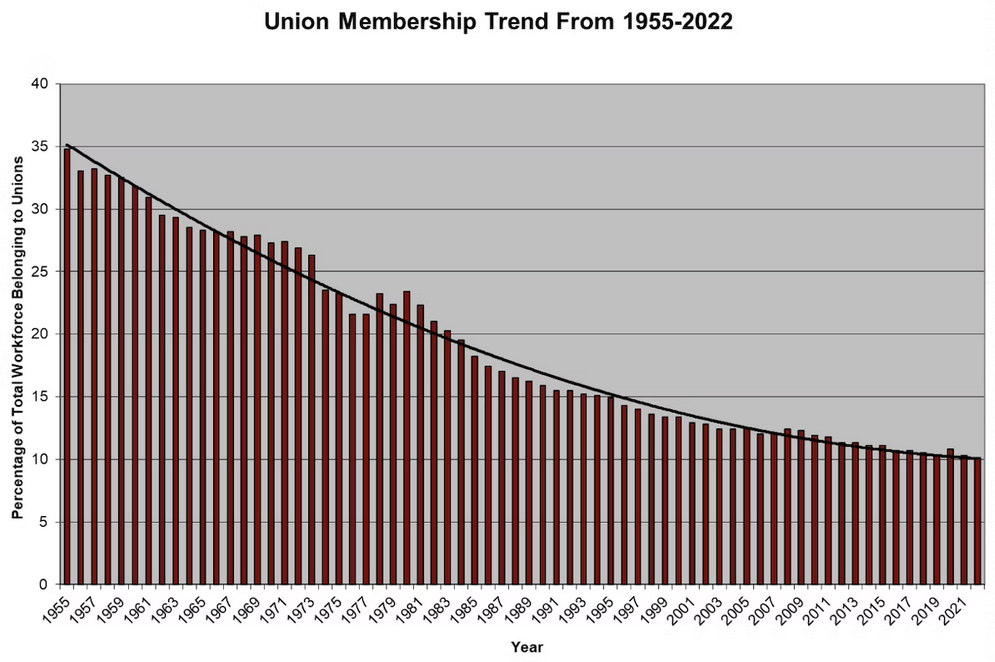
Despite an increase in buzz and news stories about labor organizing in recent years, actual union membership in the US is continuing its long decline. The most recent statistics show a 10.1% union density in 2022, the lowest on record. 

The image is of a graph of union density in the US from 1955 to 2022, showing a steady downward slope from 35% density in 1955 to 10% density today.
Source.

All of the respectable ideas for fixing this problem have been tried and failed. On the fringes of the official labor movement is an idea that doesn’t get much airtime but might have the ingredients of an effective solution: To save the labor movement we have to abandon the Union movement. 

I capitalize the U in union deliberately to designate the form of union that has become historically dominant in the US. Such Unions include all of the big-name ones in the AFL-CIO and all of the other prominent unions in the US today. Such Unions have two distinguishing features. First, they contain no-strike clauses that prohibit workers from withholding their labor for the duration of the union contract. Second, they contain management rights clauses that take away union voice and influence from workers over job conditions and that declare management alone has the “right to manage” the workplace. Together, these Union clauses amount to telling workers to shut up and get back to work, something workers now hear as much from their Union reps as from their bosses.

Two worker radicals and writers who posed a different vision of unionism were Stan Weir and Martin Glaberman, authors of, respectively, Singlejack Solidarity (2004) and Punching Out & Other Writings (2002) (out of print and expensive to buy used, but downloadable as a pdf). Both books are collections of the authors’ shorter writings and were published shortly after their authors’ deaths. 

Continue reading
Mostafa Meraji, Vakil Mosque in Shariz, Iran. Big faded brick pillars recede into a dark open hall with an ornately blue and yellow-tiled arching ceiling.

Relationship-Based Organizing with Thorny Coworkers

[This post is part of my series on relationship-based organizing. If you are new to my blog, I recommend checking out earlier entries in this series first.]

Relationship-based organizing (RBO) is a method of union organizing that centers building social relationships with coworkers. Everyone likes social relations, especially in our hyper-isolating and individualizing and anti-social capitalist society, so RBO is just puppy dogs, lollipops, and rainbows all of the time, right?

Of course not. One of the first things that goes through new organizers’ minds when they think about how to talk to their coworkers and build relationships is the question of those coworkers that aren’t easy to talk to or build relationships with. I’ll call them “thorny coworkers.” Like your biological family or your neighbors, you usually don’t have much control over who your coworkers are and you have to find some way to live with what you got. The first temptation upon realizing this is to think that maybe the organizing can just leave the thorny coworkers out of it. Depending on the grievances and social dynamics of any particular moment, this might be an entirely plausible strategy. 

However, as a general approach to organizing your coworkers, leaving the thorny coworkers out of your organizing entirely will likely backfire or severely restrict what you can win. Every coworker you exclude from organizing is another coworker who becomes easy pickings for the boss to turn against you. Every once and a while, you might be at a workplace where just one or two coworkers are thorny and ignoring them doesn’t really create any problems. 

Continue reading

Notes on Social Relationships in Workplace Organizing

[This post is part of a series on relationship-based organizing.]

Everyone can organize, and everyone’s organizing will be stronger if they drop the popular image of organizing they have in their head. This image often singles one person out as separate from the community they belong to, which already is a mistake. The prototypical organizer in the activist imagination is a charismatic personality, a forceful public speaker, overflowing with confidence, capable of acts of bravery and intensity, spends all of their time glued to pursuing their political vision, and who we all look at with awe. If you have some of these traits, maybe they’ll be helpful for you. At the same time, I think the polar opposite traits are equally effective at organizing if we properly understand what organizing is about.

Union organizing is often portrayed, in popular media as well as union training materials, as really flashy. It occasionally is, but when it’s not flashy newer organizers often feel confused or get stuck trying to figure out what they’re supposed to be doing.

I hope to show that the things that make a workplace organizer good are things that everyone already has inside them, which is the ability to relate to others. It is something everyone can get better at and do with intention, but the most fundamental and important skill of organizing is just building relationships with those around you.

In my own development as an organizer and in talking with others, I’ve come to realize that the role relationships play in organizing is often different than how that role is talked about. In the intro post on relationship-based organizing, I criticized how relationships are so often instrumentalized in organizing, with the organizer using others for political goals. In this post I want to discuss more broadly the many ways that building relationships is the foundation of strong organizing. 

Continue reading