The photo is a close up of a quilt of made up of concentric squares of browns, reds, and yellows. The fabric coloring gives the impression of diagonal bands of dark and light from top left to bottom right.

“Never Give Up the Right to Strike”: An Introduction to No-Strike Clauses

[This post is part of my series on union organizational structures.]

Years ago I came across the quote, the source now forgotten, “My philosophy of unions is simple: never give up the right to strike.” At the time I didn’t fully understand what that meant, but it stuck with me. Over the years of reading labor history and reflecting on my own workplace organizing I’ve gradually realized that that quote encapsulates much of what I now believe about unions.

One of the main ways workers give up the right to strike today is through their union contracts, 98% of which contain “no-strike clauses” forbidding workers from withholding their labor for the duration of the contract. No-strike clauses are usually written in expansive terms. For example, the no-strike clause in the union contract at my job elaborates that any slow down or alteration of or deviation from or interference with the work assignment is prohibited. This amounts to a near-blanket ban on worker direct action against their employer. 

Continue reading
Not My Union: The Workplace Politics of Stan Weir and Martin Glaberman

[This post is part of a series on relationship-based organizing.]

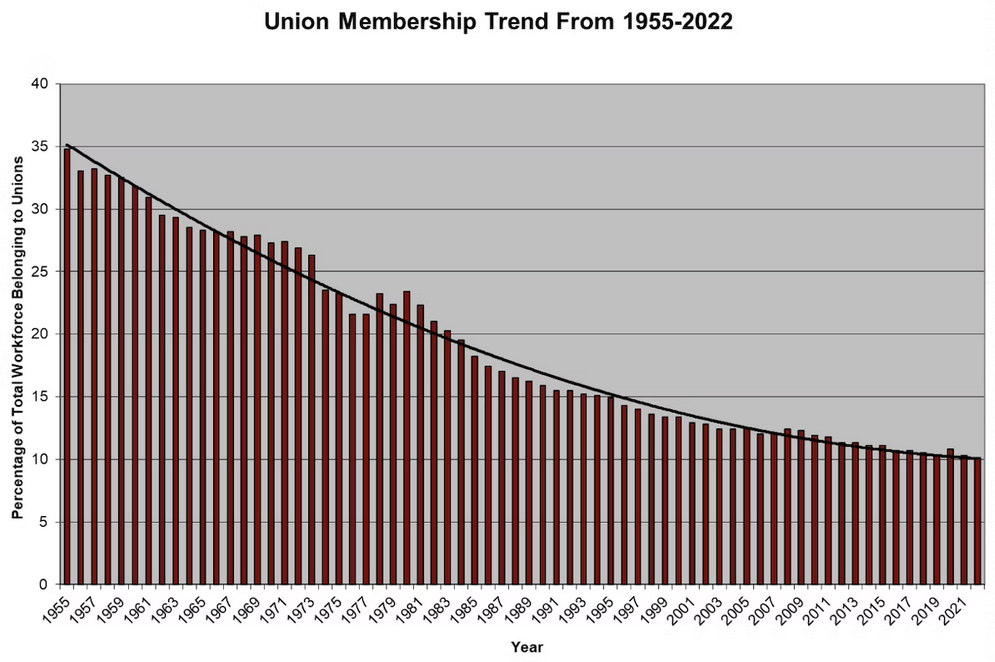
Despite an increase in buzz and news stories about labor organizing in recent years, actual union membership in the US is continuing its long decline. The most recent statistics show a 10.1% union density in 2022, the lowest on record. 

The image is of a graph of union density in the US from 1955 to 2022, showing a steady downward slope from 35% density in 1955 to 10% density today.
Source.

All of the respectable ideas for fixing this problem have been tried and failed. On the fringes of the official labor movement is an idea that doesn’t get much airtime but might have the ingredients of an effective solution: To save the labor movement we have to abandon the Union movement. 

I capitalize the U in union deliberately to designate the form of union that has become historically dominant in the US. Such Unions include all of the big-name ones in the AFL-CIO and all of the other prominent unions in the US today. Such Unions have two distinguishing features. First, they contain no-strike clauses that prohibit workers from withholding their labor for the duration of the union contract. Second, they contain management rights clauses that take away union voice and influence from workers over job conditions and that declare management alone has the “right to manage” the workplace. Together, these Union clauses amount to telling workers to shut up and get back to work, something workers now hear as much from their Union reps as from their bosses.

Two worker radicals and writers who posed a different vision of unionism were Stan Weir and Martin Glaberman, authors of, respectively, Singlejack Solidarity (2004) and Punching Out & Other Writings (2002) (out of print and expensive to buy used, but downloadable as a pdf). Both books are collections of the authors’ shorter writings and were published shortly after their authors’ deaths. 

Continue reading