
A creamy white fabric is covered with a winding series of small flowers, leaves, stems growing from left to right. The design is colored in brown.

“Don’t run for executive board”: How to Take Over Your Union from the Bottom Up

[This post is part of my series on union organizational structures.]

Many workers today find themselves asking, “If unions in general are good, why does my union suck?” The member meetings are unbearably tedious, abuses and unsavory conditions are widespread at work, wages keep falling against inflation, health insurance premiums keep going up, and, worst of all, none of the union’s initiatives or campaigns seem to be helping. 

For many workers who are dissatisfied with their union, taking over the executive board appears like the logical way to make their unions better. They think that the union itself is a good thing and all that needs to be done is replace the bad leadership with good leadership. As common as this mindset is among union activists, it ignores a deeper and structural critique of why today’s unions are so dissatisfying in the first place. More often than not, such efforts to win union leadership end up perpetuating the very structures that are responsible for the dissatisfaction in the first place.

Unions have different structures and dimensions that are worth teasing apart and evaluating separately. What’s good about the union is the bringing together of workers to fight for better a better life. At its core, the union is democratic because workers are taken together as all having equal standing and voice. The union is militant because it’s based on workers taking action together. The union is radical because workers deciding and acting together in their own interests sets them apart from and against the overarching economic structures of society wherein workers merely exist to be squeezed by investors for profits.

Continue reading
Not My Union: The Workplace Politics of Stan Weir and Martin Glaberman

[This post is part of a series on relationship-based organizing.]

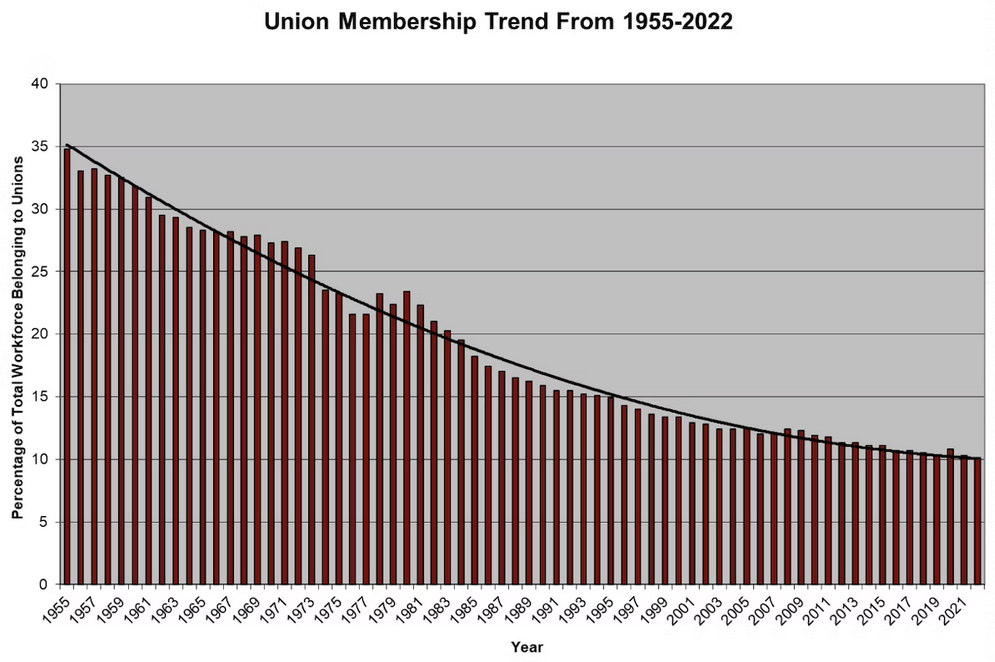
Despite an increase in buzz and news stories about labor organizing in recent years, actual union membership in the US is continuing its long decline. The most recent statistics show a 10.1% union density in 2022, the lowest on record. 

The image is of a graph of union density in the US from 1955 to 2022, showing a steady downward slope from 35% density in 1955 to 10% density today.
Source.

All of the respectable ideas for fixing this problem have been tried and failed. On the fringes of the official labor movement is an idea that doesn’t get much airtime but might have the ingredients of an effective solution: To save the labor movement we have to abandon the Union movement. 

I capitalize the U in union deliberately to designate the form of union that has become historically dominant in the US. Such Unions include all of the big-name ones in the AFL-CIO and all of the other prominent unions in the US today. Such Unions have two distinguishing features. First, they contain no-strike clauses that prohibit workers from withholding their labor for the duration of the union contract. Second, they contain management rights clauses that take away union voice and influence from workers over job conditions and that declare management alone has the “right to manage” the workplace. Together, these Union clauses amount to telling workers to shut up and get back to work, something workers now hear as much from their Union reps as from their bosses.

Two worker radicals and writers who posed a different vision of unionism were Stan Weir and Martin Glaberman, authors of, respectively, Singlejack Solidarity (2004) and Punching Out & Other Writings (2002) (out of print and expensive to buy used, but downloadable as a pdf). Both books are collections of the authors’ shorter writings and were published shortly after their authors’ deaths. 

Continue reading

The Contradictions of Paid Staff in the Union Movement, Part III

[This post is part of my series on union organizational structures. See also Parts I and II.]

A few years ago I was solicited to apply for a staff job in the union I’m a member of and was told that if I applied I’d likely get it. On the one hand, this was a bit of an ego boost to know that I was respected enough for my organizing to get this kind of invitation. Without the job title and the status of being a “professional” organizer that comes with being paid for it, society views your efforts as less serious and merely recreational.

I also knew that if I got the organizer job that my annual income would nearly double. That certainly was appealing in some ways, but it’s not what my politics and beliefs suggested was the best way to build the union movement and create the wider social change that I sought. Being in a position where I didn’t have large financial obligations like lots of debt or needing to be a breadwinner for a family, I could turn down such a salary and stay true to my vision of change. 

Continue reading

The Contradictions of Paid Staff in the Union Movement, Part II

[This article was originally written for the Industrial Worker and is part of my series on union organizational structures.]

Staff Organizers vs. Worker Organizers

How staff organizers navigate the contradictions of capitalist unionism, as detailed in Part I, informs how they differ from and interact with worker organizers.

When staff members are sincerely trying to nurture worker power, they build relationships with workers and support them as they navigate organizing in the workplace. However, the relationship between the worker and staffer is inherently supplemental and not the source itself of worker power, as the relationship between the staff and worker isn’t based in the workplace itself. The staff and the worker don’t together take action by withholding their labor or implementing workplace policy through their own control of their collective labor in the workplace. The staff stands outside of the workplace, while workers build and exercise power with each other in the workplace.

Continue reading

The Contradictions of Paid Staff in the Union Movement, Part I

[This article was originally written for the Industrial Worker and is part of my series on union organizational structures.]

A recent report on unions in the US decried their lack of investment in organizing despite immense and growing assets. Unions have nearly doubled their net assets from $15 billion in 2010 to $29 billion as of 2020 but have also cut their staff by 19% and lost 3.2% of their membership over that period. The report calls for a massive investment of union resources in organizing, including hiring 20,000 more union organizers at an annual cost of $1.4 billion.

Why aren’t unions aggressively organizing if doing so would increase their membership numbers and dues income? Would hiring 20,000 more staff super-charge organizing and lead to a resurgence in labor militancy and victories?

Many union members reading this probably belong to unions that are considering raising dues to pay for more staff. This is a constant conversation among leadership in my mainstream union, and the justification for higher dues and more staff is usually that they are needed to organize for the next big contract campaign or to launch some political initiative.

You can probably sense my lack of enthusiasm for such plans, though I don’t want to reduce the issue to a knee-jerk reaction against paying more dues. How much unions collect in dues, how they spend those dues, and how they use staff raises much more fundamental questions about the union movement. 

Continue reading