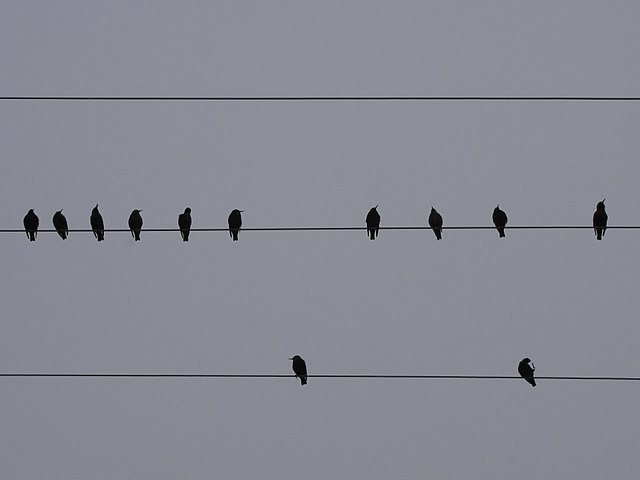
A black silouette of a dozen birds sitting on power lines against a dark grey sky.

Baseline Anarchism

[For more of my posts on anarchism visit this page.]

I was hanging out in the woods with a few old friends over a long weekend recently and we got to debating about our usual political topics. One friend is a Silicon Valley brand of conservative libertarian, another is a progressive liberal, and I am the resident leftist anarchist. The progressive is more willing to consider other viewpoints and finds some aspects of both the libertarian and the anarchist perspective appealing, whereas the libertarian and myself are much more rigid and uncompromising in our contrasting and long-standing convictions. As such, the libertarian and myself end up trying to win over the progressive on various points. Our hours-long debates are mostly cordial but sometimes get heated. Nonetheless, we all seem to enjoy these skirmishes.

During this sojourn in the woods, I came up with a way of framing anarchist politics that captured better than any other phrasing I’ve come across the distilled essence of my commitment to anarchism. The progressive asked me what about anarchist politics was appealing. In response I posed the following question, “Would you ever want to have less influence over the things in your life that you care about most?” 

Continue reading
The photo is a close up of a quilt of made up of concentric squares of browns, reds, and yellows. The fabric coloring gives the impression of diagonal bands of dark and light from top left to bottom right.

“Never Give Up the Right to Strike”: An Introduction to No-Strike Clauses

[This post is part of my series on union organizational structures.]

Years ago I came across the quote, the source now forgotten, “My philosophy of unions is simple: never give up the right to strike.” At the time I didn’t fully understand what that meant, but it stuck with me. Over the years of reading labor history and reflecting on my own workplace organizing I’ve gradually realized that that quote encapsulates much of what I now believe about unions.

One of the main ways workers give up the right to strike today is through their union contracts, 98% of which contain “no-strike clauses” forbidding workers from withholding their labor for the duration of the contract. No-strike clauses are usually written in expansive terms. For example, the no-strike clause in the union contract at my job elaborates that any slow down or alteration of or deviation from or interference with the work assignment is prohibited. This amounts to a near-blanket ban on worker direct action against their employer. 

Continue reading

Critical Book Review: Power, Manipulation, and Burnout in Pitkin’s On the Line

On the Line: Two Women’s Epic Fight to Build a Union (2022) by Daisy Pitkin is probably the most well-written book about the labor movement I’ve ever read. The book is an account of the author’s experience as a union organizer in the mid-2000s written as a long letter to the worker organizer she developed a close bond with, Alma. The characters are relatable, passionate, courageous, and draw you in. The author’s first-person organizing stories are interwoven with important union history to astutely draw out themes of labor struggle as true of capitalism of years past as they are today. An allegory of the moth’s desire to fly towards the light of a fire and to its own certain death illustrates the drive union organizers have to keep fighting bosses despite the self-destructive effects these fights have on their mental and social lives. If you like well-written books, you should read this book on these merits.

If you are looking for any kind of inspiration or positive model for what union organizing can be like, you should read a different book. On most pages Pitkin has a caring voice as a writer and a gentle touch as an organizer, but gentleness by itself is no protection from the machinations of personal and institutional power that subtly slice through the chapters. You almost forget how unseemly an image of union organizing this is because the storytelling is by turns electrifying, stirring, and heart-tugging. I’ll leave it to other reviewers to discuss the book’s positive aspects, and I’ll confine myself to the political message and meaning of the story for workers and organizers today.

Continue reading
The image is of the ruins of an old city, with dark yellow stone walls and pillars on a hillside. All of the buildings have long crumbled away. The image is of Jerash, a city in Jordan that dates back to 7,000 BCE.

Helping Coworkers Overcome Ambivalence Towards Change (Listening Series, Part 3)

[Parts 1 and 2. These posts on listening are part of my larger series of posts on relationship-based organizing.]

In the previous post, I used the example of Connor being ambivalent about standing up to his boss Bill to illustrate how to use the general listening tactics OARS (open-ended questions, affirmations, reflections, summaries) to build trust and strengthen the relationship. While building trust is one essential ingredient, in the counseling approach of Motivational Interviewing (MI) there’s an additional set of practices that are used to help people get past ambivalence and that can be applied to specific such organizing situations. While these are not essential organizing tools that every organizer should know and practice (like AEIOU), I nonetheless have found them helpful in talking with those coworkers who seem stuck.

The goal of these methods is evoking the will to change that people already have inside of them, tapping those enormous reserves of motivational energy that everyone possesses but can be suppressed by ambivalence. The main way to do this is to support people in expressing their values, interests, abilities, and aims out loud. “In particular this process occurs in MI by literally talking oneself into change. People tend to become more committed to what they hear themselves saying.” 

Continue reading
The image shows the old pillars of the Hera Temple in Greece, built originally in 450BC. The pillars are lined in rows and there's no remaining roof but a blue sky in the background.

Good Listening Skills for Organizing (Listening Series, Part 2)

[This series on listening is part of my larger series of posts on relationship-based organizing.]

In Part 1 of this series, I discussed how listening related to organizing at a more general level. In this post I get into specifics of how to practice good listening. Most of these listening skills apply to social relationships in general, but here I present them in the context of union organizing.

Motivational Interviewing

Motivational Interviewing (MI) is a form of counseling that a reader first commented about on my blog, noting how it sounded similar in a lot of ways to how I write about relationship-based organizing. Piquing my interest, I started to look into MI, found a lot that I resonated with, and discovered some new angles for looking at my organizing.

Continue reading