A grainy white and black photo of a bridge being built over a wide river. Long metal arches are being built between concrete pylons.

Building Organizing Networks through 1-on-1 Conversations

[This post is part of a series on 1-on-1 organizing conversations.]

For those who get really involved in union activism or political activism, there are different ways that such activists use their time. There are what I call the “floater” activists. Floaters go to all the meetings, go to all the protests and rallies, and spend a lot of time socializing with other activists. I call them floaters because they float around to everything, but this floating happens without being social rooted or having deeper political designs. Floaters will often think they have the most influence on social change because they do everything and go to everything, but I think this detracts from a more grounded approach that is more than the sum of its parts.

In contrast to the floaters, there are the activist “builders.” There are two things that builders do: 1) they build and cohere networks of people who are affected by a problem, and 2) they organize these networks in a particular direction to address that problem.

Continue reading

A creamy white fabric is covered with a winding series of small flowers, leaves, stems growing from left to right. The design is colored in brown.

“Don’t run for executive board”: How to Take Over Your Union from the Bottom Up

[This post is part of my series on union organizational structures.]

Many workers today find themselves asking, “If unions in general are good, why does my union suck?” The member meetings are unbearably tedious, abuses and unsavory conditions are widespread at work, wages keep falling against inflation, health insurance premiums keep going up, and, worst of all, none of the union’s initiatives or campaigns seem to be helping. 

For many workers who are dissatisfied with their union, taking over the executive board appears like the logical way to make their unions better. They think that the union itself is a good thing and all that needs to be done is replace the bad leadership with good leadership. As common as this mindset is among union activists, it ignores a deeper and structural critique of why today’s unions are so dissatisfying in the first place. More often than not, such efforts to win union leadership end up perpetuating the very structures that are responsible for the dissatisfaction in the first place.

Unions have different structures and dimensions that are worth teasing apart and evaluating separately. What’s good about the union is the bringing together of workers to fight for better a better life. At its core, the union is democratic because workers are taken together as all having equal standing and voice. The union is militant because it’s based on workers taking action together. The union is radical because workers deciding and acting together in their own interests sets them apart from and against the overarching economic structures of society wherein workers merely exist to be squeezed by investors for profits.

Continue reading

Not My Union: The Workplace Politics of Stan Weir and Martin Glaberman

[This post is part of a series on relationship-based organizing.]

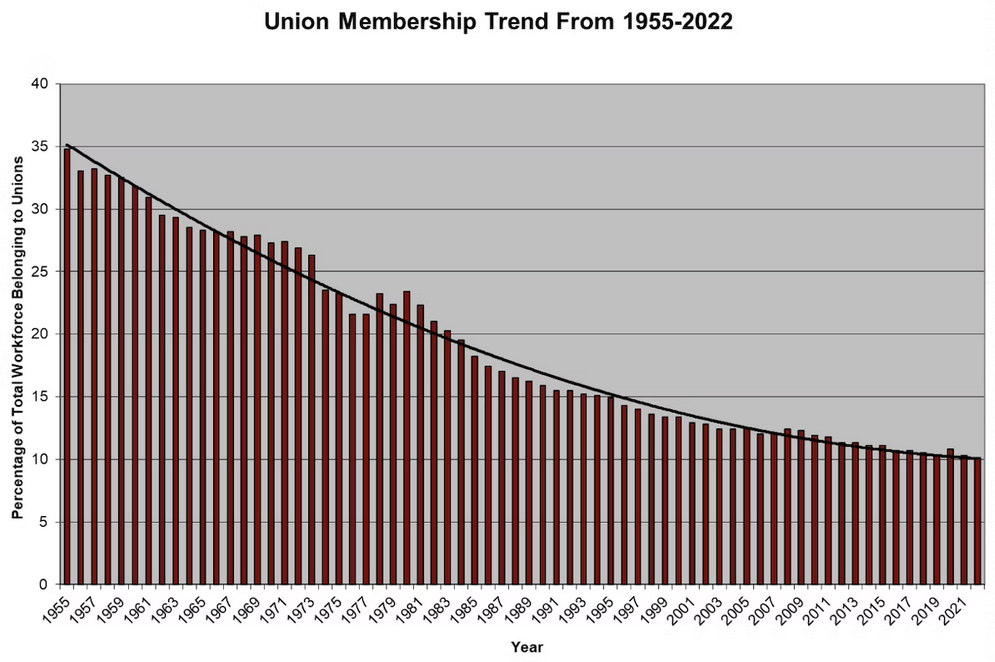
Despite an increase in buzz and news stories about labor organizing in recent years, actual union membership in the US is continuing its long decline. The most recent statistics show a 10.1% union density in 2022, the lowest on record. 

The image is of a graph of union density in the US from 1955 to 2022, showing a steady downward slope from 35% density in 1955 to 10% density today.
Source.

All of the respectable ideas for fixing this problem have been tried and failed. On the fringes of the official labor movement is an idea that doesn’t get much airtime but might have the ingredients of an effective solution: To save the labor movement we have to abandon the Union movement. 

I capitalize the U in union deliberately to designate the form of union that has become historically dominant in the US. Such Unions include all of the big-name ones in the AFL-CIO and all of the other prominent unions in the US today. Such Unions have two distinguishing features. First, they contain no-strike clauses that prohibit workers from withholding their labor for the duration of the union contract. Second, they contain management rights clauses that take away union voice and influence from workers over job conditions and that declare management alone has the “right to manage” the workplace. Together, these Union clauses amount to telling workers to shut up and get back to work, something workers now hear as much from their Union reps as from their bosses.

Two worker radicals and writers who posed a different vision of unionism were Stan Weir and Martin Glaberman, authors of, respectively, Singlejack Solidarity (2004) and Punching Out & Other Writings (2002) (out of print and expensive to buy used, but downloadable as a pdf). Both books are collections of the authors’ shorter writings and were published shortly after their authors’ deaths. 

Continue reading
The image is looking up at the large ornately buttressed ceiling of an open chamber with pillars coming down.

A Critical Survey of Left Unionisms: McAlevey, Burns, Moody, Syndicalism, Permeationism, and Relationship-Based Organizing

[This post is part of my series on relationship-based organizing. A pamphlet version of this post is available for download here.]

Unions and organizing are complex things with many parts, dimensions, and dynamics. Major theories of unionism each build a worldview that fit these concepts together in a coherent way and that advance a particular set of union practices. The main theories on left union theory and strategy today include those of Jane McAlevey, Joe Burns, Kim Moody and Labor Notes, and reform caucus unionism. Other left unionisms, dominant at different points in US history but less prominent today, include syndicalism as practiced by the Industrial Workers of the World (IWW) and permeationism as practiced by Marxist-Leninist organizations. These theories are not static nor mutually exclusive, as they often overlap, get mixed and matched in practice, and evolve over time.

Different unionisms will weigh the importance of the different aspects of unionism differently. A useful way to survey the landscape of left unionisms is by showing what each one locates as its central concepts. I briefly draw out some of the main features of these union theories as well as some of the critiques of them. 

Continue reading

The Contradictions of Paid Staff in the Union Movement, Part III

[This post is part of my series on union organizational structures. See also Parts I and II.]

A few years ago I was solicited to apply for a staff job in the union I’m a member of and was told that if I applied I’d likely get it. On the one hand, this was a bit of an ego boost to know that I was respected enough for my organizing to get this kind of invitation. Without the job title and the status of being a “professional” organizer that comes with being paid for it, society views your efforts as less serious and merely recreational.

I also knew that if I got the organizer job that my annual income would nearly double. That certainly was appealing in some ways, but it’s not what my politics and beliefs suggested was the best way to build the union movement and create the wider social change that I sought. Being in a position where I didn’t have large financial obligations like lots of debt or needing to be a breadwinner for a family, I could turn down such a salary and stay true to my vision of change. 

Continue reading