
[This post is part of a series on 1-on-1 organizing conversations.]
“You can get all your ideas across just by asking questions, and at the same time you help people to grow and not form a dependency on you. To me it’s just a more successful way of getting ideas across.” – Myles Horton in conversation with Paolo Freire in the book We Make the Road by Walking.
Myles Horton co-founded the Highlander Folk School in Tennessee in 1932 and developed a model of popular education that played an important role in stimulating the bottom-up leadership of both the 1930s labor movement and the 1960s civil rights movement. Horton paid close attention to crafting and wielding questions as an essential tool of grassroots organizing.
When I observe someone organizing around a political or workplace problem, the first thing I pay attention to is how they are asking questions. Is the organizer just asking questions to pull the other person into the conversation without really listening to them? Is the organizer just waiting their turn to say what they think the answer is? Are the questions just a subtle way for the organizer to control the conversation? Bad question-asking is as useless and harmful as trying to boss other people around.
Rather, good question-asking is for a grassroots organizer what the wing is to a bird. More than a tool, it is the basic appendage the organizer uses to maneuver through social relationships and political ideas. Like a sparrow that dives and weaves through thick forest with ease, so does the adept organizer use questions for every dip and turn. Both flight and posing good questions promote a freedom to explore.
Yet, organizing discourse pays scant attention to question-asking. Organizing guides will tell you what questions to ask in certain circumstances, and while I think such guides are often very useful, there’s also a more fundamental way that good organizers use questions.
Question-asking can be a mode of communicating ideas. On its surface, asking questions might only seem appropriate for an organizer when the organizer doesn’t know something. On the contrary, asking questions is also effective when the organizer does know something.
“So I just found that if I know something well enough, then I can find a way in the discussion that’s going on to inject that question at the right time, to get people to consider it. If they want to follow it up, then you ask more questions, growing out of that situation.” – Myles Horton
Organizing is about bringing people together to take action to solve common problems (I use the term “organizer” to refer to anyone who does this, not as a professional designation or self-appointed authority). But before people can take action together, they have to understand their social context and how their power can be leveraged by coming together with others. Asking questions is that part of organizing that generates shared understanding that makes collective action possible.
“I use questions more than I do anything else. They don’t think of a question as intervening because they don’t realize that the reason you asked that question is because you know something. What you know is the body of the material that you’re trying to get people to consider, but instead of giving a lecture on it, you ask a question enlightened by that. Instead of you getting on a podium you put them on a podium.” – Myles Horton
Reformulate Ideas as Questions
Let’s make this concrete with a simple example. In a traditional 1-on-1 organizing conversation there’s a place in the conversation where the organizer should warn people against the dangers of being loose-lipped about plans to take collective action against the boss. Say a group of workers are planning to walk into the boss’s office before shift change to demand that some workplace problem be addressed. Many workplace actions have been scuttled by workers who are eager to fight back and excitedly tell a few too many people what they’re planning to do. The common result of oversharing such sensitive information is that word gets back to the boss and workers get individually called into the boss’s office to be yelled at, disciplined, or fired. But if the organizer goes around insisting to coworkers, “Don’t tell our plans to anyone,” that can feel bossy and patronizing.
Rather than expressing this idea to coworkers in the form of a direction, it’s best to reformulate this idea in the form of a question. “What do you think the boss would do if they heard about our plans?” The organizer already knows the answer, but that’s not what’s important. In response to such a question, the coworker will think through the power dynamics at work. Most workers have a pretty strong and intuitive sense of how a hostile boss will respond if they learn about worker plans for an action. When given the opportunity to think that through, most workers will realize for themselves the importance of not letting this info get into the wrong hands. What’s important about expressing ideas as questions is that it encourages people to think for themselves about their circumstances. When they come to the idea by reflecting on the situation for themselves, then they’ll believe it much more firmly because they’ll know why they believe it.
To demonstrate further, let’s continue the example. Say the boss is out sick on the day workers are planning to march into their office. Perhaps the organizer thinks it’s best to delay the action until the boss is back instead of trying to take action against the assistant supervisor. Rather than going around commanding everyone, “We must not do this today and wait for the boss to be back,” it’s much more effective to just ask coworkers, “Should we go ahead with our action or wait until the boss is back?”
If a coworker expresses an idea that the organizer is unsure about, the organizer can respond again in the form of a question. A coworker might declare, “This issue is too important to wait, we have to act today.” Resist the urge to respond with a directive (“We must wait”) or counter-statement (“Acting today would be ineffective”), and instead respond again with a question. An organizer can ask, “Do you think the assistant supervisor has the power to give in to our demand?”
The Logic of Question-Asking
Walking through thought-processes together using questions and checking in at each step for agreement, alternative ideas, and resolution, is a very different form of discussion from presenting complex ideas all at once and then debating people about them. The latter is the approach that people take when they mistake the task of the organizer as forcefully persuading people of things.
Let’s synthesize the main ideas from the examples and discussion above by distilling the logic of good question-asking. If you have an idea you want to express to others in an organizing context, you can turn it into a question by first backing up and asking yourself why you think that idea is valuable. For example, perhaps you think it’s worthwhile to wait until the main boss is back at work because the assistant supervisor doesn’t have the power to concede your demand and will have to relay the demand back to the main boss anyway. But if the main boss hears the demand only second-hand from the assistant supervisor, they won’t feel the pressure of the action in the same way as if they heard the demand directly from the workers in the context of an action.
In thinking through why an idea is valuable, you tease apart the assumptions and reasons that underlie an idea and how that idea relates to the needs of a particular situation. Once you understand the assumptions and reasons for why you think something, only then are you able to pose a focused question inviting your coworker to consider those assumptions and reasons for themselves.
Question-asking invites others to investigate ideas together instead of just presenting finished conclusions that others feel pressured to agree or disagree with in the moment. Productive disagreement and possible resolution are made smoother when the underlying assumptions and reasons are explicit instead of murky or hidden.
The logic of good question-asking can be turned into a formula:
- Start with an idea (“We shouldn’t tell our plans about action to anyone not involved in the action itself.”)
- Break the idea down into its assumptions and reasons (“If the boss hears about our plans, our action will be undermined and our demands will not be won.”)
- Pose a question that asks people to think through the assumptions and reasons for themselves (“What do you think would happen if the boss heard about our plans?”)
To extend this formula to navigate disagreement, the formula can be extended simply as:
- If the organizer and the worker disagree (“It doesn’t matter if the boss hears about our plans because we’re going to take action no matter what”), then the organizer’s task is to formulate a response in the form of a question to further investigate the underlying assumptions and reasons that are at the root of the disagreement (“What if the boss fires one of us before we get to the action?”).
The organizer’s task isn’t to use questions for just one part of the discussion, but to link together a series of questions that leads to more developed ideas and plans.
Giving Direction to Your Question-Asking
Notice also how this form of question-asking has a directionality to it. You’re not just asking random questions in a scattershot manner to “open up space for discussion” for its own sake. Rather, the questions you are asking provide a path and possible destinations. By paying close attention to the assumptions and reasons that underlie the ideas being considered, you can calibrate your questions to the precise areas of potential disagreement and potential gaps in shared understanding that would impede movement towards collective action.
Thus, good question-asking requires the organizer to keep one eye on the current state of the conversation and the other eye on where the conversation is going. With those two things in view, the organizer can pose questions that lead from point A to points B, C, and so on. The general direction is from isolated and varied opinions about a workplace problem to one of shared understanding, from a place of collective inaction to one of collective action.
It’s also important that the organizer invite pushback in the case of real disagreement, slow down when there’s no obvious way forward, and be willing to drastically change direction when new ideas require it. The organizer should not tell everyone what to think and do but should stimulate a group of people to think and act together.
This all may sound difficult to manage in real time within the context of an already complicated organizing situation. But it’s also something anyone can start doing and get better at with practice. This communication pattern is what many good organizers have learned to do instinctively.
The degree of familiarity and trust between workers will dictate the speed at which these conversations go. If you’ve never talked with a particular coworker about a workplace issue before, you might have to proceed more slowly as you examine more basic assumptions about the problem and reasons for taking action. However, if a group of workers have worked alongside each other for years and have taken action together before, these conversations can proceed quickly.
Some people might be suspicious of this form of question-asking as being dishonest or manipulative. Certainly, a manipulative person can use the power of question-asking to deceive and mislead people. However, there’s a totally open and honest way to use these tools as well. In asking questions, the organizer should not feign ignorance or hide their intentions.
“I’ve never hesitated to tell anybody what I believe about anything if they ask me. I see no reason to tell them before they get ready to listen to it, and when they ask a question, then they’re ready to listen to it. I just don’t see any point in wasting your energy trying to force something on people.” – Myles Horton
Political Education
The above examples are framed in terms of concrete organizing challenges, but the same logic of question-asking also applies to broader political discussion. What’s important about both kinds of conversation is people thinking through the ideas for themselves.
Let’s briefly consider another example. One common response from others that I often run into when discussing seemingly intransigent social problems is the desire for a better leader to fix the problem for us. While I think having better official leaders who can do all the hard work for us is appealing, I don’t think it’s worth investing much hope in on its own.
Using the above formula:
- Start with an idea (“Having better official leaders won’t make us better off in the long-term”)
- Break the idea down into its assumptions and reasons (“If we invest all of our power in wanting better leadership, we as people are still powerless to solve problems on our own and we become dependent on outsiders.”)
- Pose a question that asks people to think through the assumptions and reasons for themselves (“Do you think it’s more important to have the ability to solve our own problems or to have authorities who can solve our problems for us?”)
In my experience, people often just don’t believe that communities themselves can solve social problems because that doesn’t fit with the dominant narratives we’ve been told. The objection I face when advocating grassroots social movements as a better solution to social problems is people’s disbelief that grassroots social movements are powerful or even possible. To attack the root of this disagreement you can attack the dominant narratives about history that underlie it. Rather than lecturing people about the history of social issues and movements, it’s better to keep using questions. Using the above formula, one could ask “How did workers, women, people of color, etc… come to have more rights today than in the past?”
Being Proactive with Questions
The hardest part for me of using questions like this is not being reactive. I often have strong reactions when people express ideas that are contrary to my own deeply held values. When I react in disagreement by meeting others’ ideas with forceful rebuttals, the conversation loses its openness and the strategic power of question-asking is squandered.
Every time a conversation ends in frustrating disagreement, I reflect back on where I got reactive and argumentative. I reflect back on what questions I could have asked that might have kept the conversation open. The goal is not to force others to agree with me, but to stimulate curiosity and exploration of new ideas that can loosen preconceived notions and make coming to shared understanding more possible. Only through practice, reflection, and a continuing desire to have more generative conversations with others have I learned to have more patience and self-awareness to ask better questions in the moment.
Question-Asking in Practice
Question-asking is useful when someone with more experience and knowledge of a subject is trying to communicate ideas to someone newer to that subject. As a rule of thumb, the more experience and knowledge I have on a topic compared to the person I’m talking with, the more I rely on questions. In such circumstances, I can go a long time posing question after question, often only expressing my thoughts as statements when the other person asks me a question.
However, the same overall logic of question-asking applies when two people of similar degrees of experience and knowledge are talking, or even when you are using question-asking as the person with less experience and knowledge on a subject. When I’m talking with another person with a similar level of experience and knowledge on a subject, questions alternate more evenly with back-and-forths. When I know something I can express it as a question, but when I’m processing some idea in the moment, I often need to think out loud in the form of statements.
I find question-based conversations in all their forms to be thrilling, as exploring political situations and ideas with someone creates so many possibilities for new ways of seeing the world. When I’m doing this effectively, the other person I’m talking with experiences the thrill of new ideas and possibilities as well, and often they will begin to use questions in the flow of the conversation in this way too.
Conclusion
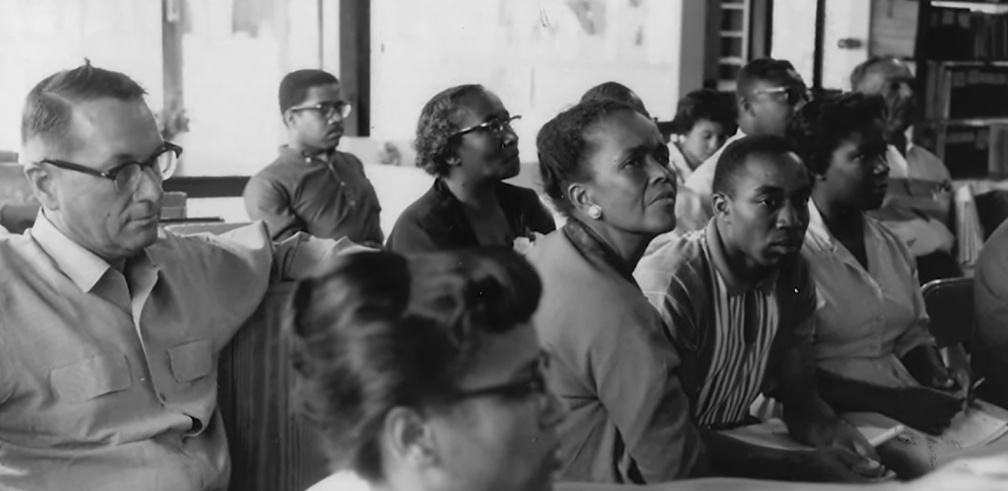
Ella Baker is another one of my question-asking inspirations. Barbara Ransby’s biography Ella Baker and the Black Freedom Movement shows how Baker helped build the Student Nonviolent Coordinating Committee (SNCC), the student wing and militant flank of the civil rights movement. SNCC engaged in many of the highest-risk, highest-reward actions of the era, such as sitting in at segregated lunch counters and riding segregated interstate buses in the face of violent white mobs. By providing the leading edge of direct action organizing that eventually toppled Jim Crow, SNCC was one of the most influential grassroots organizations of the 20th century. SNCC’s militancy was not molded by charismatic authority or conformity to dogma but was fostered by an intense curiosity about how to make the world a better place. As Ransby writes:
“According to SNCC member Prathia Hall, Baker’s style of teaching was a lesson in itself. She ‘was a consummate teacher, always opening us to new understandings,’ Hall remembered. ‘It was never the pounding, ‘you must do this, you must do that,’ but by raising a question and then raising another question and then helping us to see what was being revealed through the answer was her mode of leadership. She was the one who taught us how to organize … to organize in such a way that when we left, the people were fully capable of carrying on the movement themselves.’ Baker taught by inquiry and by example. She did not tell people what to do or think; she guided them toward answers and solutions by teasing out the ideas and knowledge that already existed within the group, and within individuals, and then by encouraging people to express that information in their own words. She was also patient enough to allow this process to unfold.
Echoing Hall’s and Ladner’s observations, a former Spelman College activist, Lenora Tait-Magubane, recalled, ‘Miss Ella would ask questions, key questions … and sometimes people don’t recognize or appreciate this as leadership…. She would sit there and she would literally almost let a meeting fall apart. People were at each other before she would intervene, because she wanted the decision to come out of the group and not be hers. She would say: ‘Well, what about so and so?’ or ‘Well, have you thought through this or that?’ She was always pushing people to think and challenging you.’ Mary King, a young white woman whom Baker recruited to SNCC through her YWCA work and who worked closely with Baker in Atlanta, remembers her mentor as a powerfully effective teacher. ‘With Socratic persistence, in her resonant and commanding voice, she would query, ‘Now let me ask this again, what is our purpose here? What are we trying to accomplish?’ Again and again she would force us to articulate our assumptions…. She encouraged me to avoid being doctrinaire. ‘Ask questions, Mary,’ she would say.’”
 Fire with Fire