
[This post is part of my series on relationship-based organizing. A pamphlet version of this post is available for download here.]
Unions and organizing are complex things with many parts, dimensions, and dynamics. Major theories of unionism each build a worldview that fit these concepts together in a coherent way and that advance a particular set of union practices. The main theories on left union theory and strategy today include those of Jane McAlevey, Joe Burns, Kim Moody and Labor Notes, and reform caucus unionism. Other left unionisms, dominant at different points in US history but less prominent today, include syndicalism as practiced by the Industrial Workers of the World (IWW) and permeationism as practiced by Marxist-Leninist organizations. These theories are not static nor mutually exclusive, as they often overlap, get mixed and matched in practice, and evolve over time.
Different unionisms will weigh the importance of the different aspects of unionism differently. A useful way to survey the landscape of left unionisms is by showing what each one locates as its central concepts. I briefly draw out some of the main features of these union theories as well as some of the critiques of them.
New organizers often enter the labor movement through one or another of these forms of unionism. However, to have a robust movement where discussion of strategy is accessible and well-informed it’s important for unionists to be familiar with a broader range of union ideas that are prominent in the movement as a whole.
This survey is written from two points of view. First, at a theoretical level I love reading all of the big labor ideas and thinkers, comparing their approaches, and assessing their usefulness and impact on the movement. Second, practically as a rank-and-file worker active in organizing at my workplace and who pays close attention to the political dynamics in my union and industry, I’ve seen each of the approaches described below studied, invoked, applied, and critiqued among the members, staff, and leadership of my union. The account given here is thus admittedly subjective, but I aim to give an even-handed overview of each type of unionism that has the benefit of helping us see the wider landscape of the left union movement.
Lastly, within this landscape I want to situate a different theory of unionism, one I’ve been developing on this blog that I call “relationship-based organizing.” I end by showing how it compares and contrasts with these other union theories.
Jane McAlevey, Technical Organizing Prowess, and the Super-Majority Strike
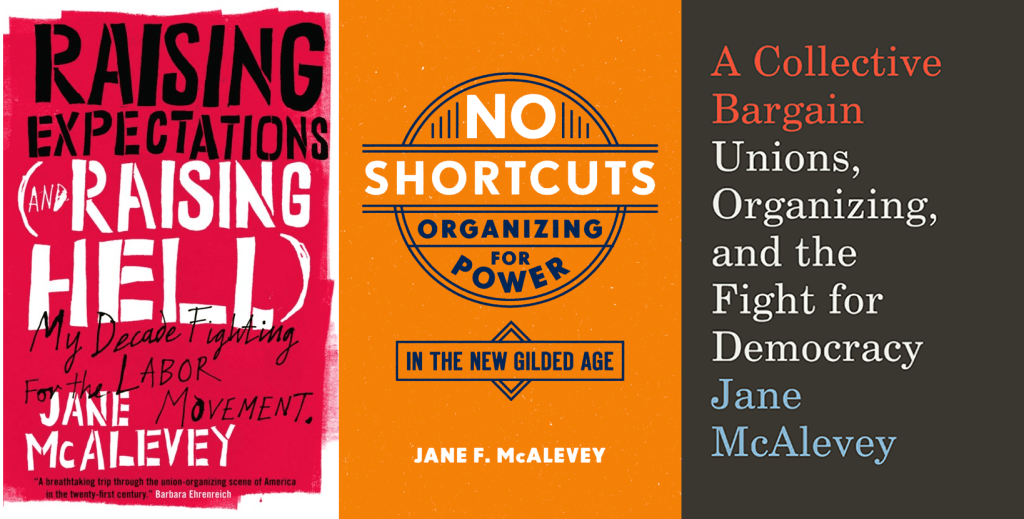
Jane McAlevey has become the face of the contemporary labor movement in many ways. Her track record of victories organizing strikes in the healthcare sector, her top-selling books on union theory and practice, and her widely attended online organizer trainings have given her a reach and visibility well beyond any other single labor figure.
McAlevey’s central union concept is the super-majority strike. While most strikes are super-majority strikes, so she’s hardly the first to champion the idea, she’s created a systematic methodology for how unions can build, step by step, towards going on and winning such strikes.
Her idea of the “structure test” is a key part of this approach. A structure test is any union action that workers take which brings them into the campaign and also “tests” the strength of the union (aka, the structure) by revealing what proportion of the total rank-and-file participate in such an action of a certain level of intensity. Structure tests are linked together in a series, from less intensity to more intensity, until a super-majority of union members are prepared to go on strike together.
Early in a contract campaign, for example, a low-intensity structure test might consist of workers wearing the same union color shirt on a particular day. A higher-intensity structure test might be involve workers taking selfies while holding a placard with a union demand on it. The images are combined and then printed out as a big photo-petition and delivered to a boss or board of directors. This is considered higher intensity because workers are publicly putting their face and name to the campaign and asked to show up in person to confront company authorities.
Structure tests enable union organizers to not just build overall momentum towards a strike, but also to assess where participation is low, such as in a certain workplace or department. Once weaknesses are identified, then organizers focus their attention on bolstering the strength of those areas so that they too participate in future structure tests and are ready to go on strike when the time comes.
McAlevey puts her own spin on a lot of traditional union organizing techniques, such as mapping who in the industry and the community has decisive power over labor disputes, identifying leaders among the workers and recruiting them into the campaign, systematically charting social relations and union involvement in the workplace, and applying organizing conversations to build member engagement and support. The attention to detail and breadth of practices she coheres into her overall strategy is holistic and impressive. McAlevey’s approach centers on using this sophisticated toolbox of organizing techniques to string together escalating structure tests towards the super-majority strike.
Despite her popularity, McAlevey is a polarizing figure within the labor movement, especially on the left. She situates herself within the tradition of big strikes going back to the insurgent worker movement inside the Congress of Industrial Organizations (CIO) in the 1930s, but others disagree with her reading of this history. Socialist ideas and organizations played an outsized role in the big union battles of the 30s, but McAlevey tends to severely downplay the role of explicitly leftist ideas and organization within labor movement messaging and strategy. The kind of political education she advocates doing in unions hues close to social democratic rhetoric about the public benefits of strong unions, their necessity in constraining wealth inequality, the right of workers to good wages and benefits, and the role of active unions in sustaining robust civic discourse and public institutions. While these are good things and she justifies this messaging for its practical use in union struggles, severing union politics from any deeper anti-capitalist analysis and commitments contrasts sharply with the other kinds of unionism discussed below.
McAlevey sees electoral politics as playing a large role in the fortunes of the labor movement. She advocates running candidates on the left wing of the Democratic Party to tax billionaires, fund social programs, and bolster worker rights much in the vein of Bernie Sanders. However, this stands in contrast to how much of the left views the Democratic Party as inherently capitalist and not something the labor movement should invest energy in trying to take over.
McAlevey’s approach tends to require a high degree of specialized training, which means that these campaigns are run by small armies of professional union staff organizers coordinated from a central union strategist (McAlevey herself in the campaigns she’s participated in). At its best, these models of organizing are responsive to and empowering to workers, but all too often these staff-heavy methods become disconnected from the rank-and-file. While some CIO fights of the 1930s relied heavily on staff, many major campaigns of the era were won in which the rank-and-file led and staff played a much more marginal role.
A big advantage of McAlevey’s methods is that they are clearly defined and outlined, which makes them easy to apply to a wide range of union contexts. The downside of such clearly pre-packaged plans is that the techniques and metrics that McAlevey lays out often become artificial goals in themselves instead of tools for building worker power. Rather than using structure tests as a way to facilitate building worker power, often I see union leaders going through the motions of structure tests or using McAlevey’s terminology without actually empowering workers.
For example, rather than using a union petition to start a conversation with a rank-and-file member and build a deeper understanding of workplace grievances and power dynamics, petition-gatherers just race around a workplace collecting signatures in order to hit their structure test targets. Wearing union t-shirts can become a frustrating exercise in futility when it never seems to be connected to the issues that workers care about. The metric becomes the goal (e.g., 90% of workers wore their shirt) instead of a tool for advancing the real goal of solving workplace problems. It’s the union organizing equivalent of teaching to the test instead of teaching to advance understanding.
Is it McAlevey’s fault that her methods get warped in such ways? Not entirely. I get the impression that she uses these techniques in a more substantive way than many of her followers and imitators do. Nonetheless, basing a whole union methodology on such metrics while discounting a deeper class analysis I think predisposes unionists to apply these techniques in such a superficial fashion.
One issue I have is how McAlevey’s nearly totalizing focus on big strikes necessarily diverts attention away from the smaller fights that happen in workplaces between workers and supervisors. Just as much as the “big” issues like wages and benefits impact worker quality of life is the plethora of “small” issues that plague workplaces, whether it’s an abusive boss or excessive workplace meetings or capriciously shifting annual budgets. These are often issues that aren’t negotiated over in collective bargaining agreements that are the subject of big strikes or they happen between contract cycles when big strikes aren’t legally available. While McAlevey doesn’t entirely ignore such smaller kinds of actions, her writing and talks make clear that they are of secondary concern to the kind of big strikes that she focuses on.
Rather than have structure tests as the building blocks towards big actions like strikes, I think smaller grievance actions are better as starting points and stepping stones. Wearing a shirt or going to a rally usually does little to put direct pressure on a target, and these kinds of structure tests often feel performative in a hollow way to members. The sole purpose of these structure tests is to build support and gauge strength that only later gets cashed out in a big strike.
In contrast, types of smaller actions that are designed to put real pressure on targets and win real demands in the here and now will feel more empowering, will lead directly to material wins, and will give workers more direct experience organizing with real stakes. Examples of such actions include marching into the boss’s office as a group to issue a demand, collectively refusing to implement the latest backwards workplace policy, or engaging in creative smaller-scale work stoppages. Mini-strikes were a primary tactic of some of the strongest and most militant unions of the 1930s and 40s. These smaller actions can be progressively scaled up to tackle bigger grievances and even into big strikes but without the feeling of empty gesturing that structure tests often evoke.
With these disagreements in mind, there’s still much to learn from McAlevey. Being familiar with her ideas also enables workers to critically relate to how these widespread methods are being discussed and deployed in their unions.
Joe Burns, Class Struggle Unionism, and the Big Demands
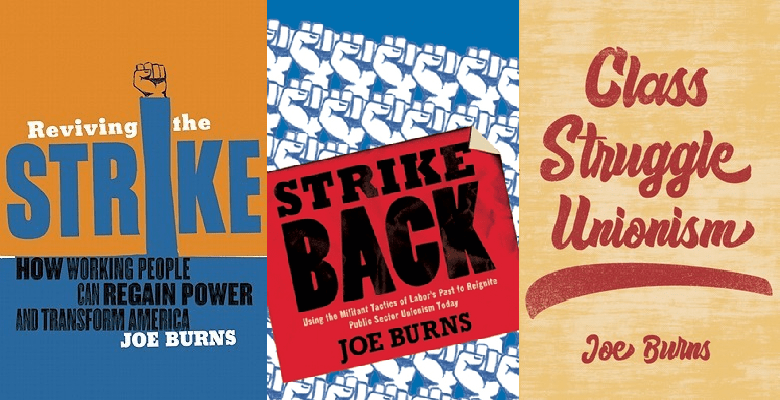
Joe Burns is the most recent arrival to the scene of left labor prominence as his 2022 book Class Struggle Unionism has become a hit and is being widely discussed. Burns is a former hospital worker turned union president turned lawyer turned top-level union negotiator for the Association of Flight Attendants. In addition to his day job as a union negotiator, for the last ten years he’s been writing about the labor movement. His first two books advocate reviving the strike as a tactic and focus on the history and strategy of strikes in the private and public sectors.
Like McAlevey, for Burns the strike is the essential tool of unions and one he argues needs to be reclaimed for the labor movement to regain power. Whereas McAlevey develops a model of unionism based on technical organizing proficiency and a toolbox of methods and tactics that advances towards big strikes, Burns is less interested in union organizing technique as the way to build a more militant and powerful labor movement. In an interview he said, “I hate that Jane McAlevey stuff. [Building for a strike is] not a linear process, I tell people. It’s like something’s in the air… It’s not because we have someone going department by department talking to people.”
Burns thinks a heightened emphasis on class struggle itself, as a relentless opposition between workers and bosses, is what will alter the fortunes of the labor movement. Unlike McAlevey, who glosses over larger questions of capitalism and socialism, Burns puts these questions at the center. Only when workers start to see their material interests clearly will they be motivated to throw themselves into labor fights.
The way unions can do this is by advancing broad demands rooted explicitly in class struggle concepts that agitate and energize workers and push whole workplaces towards the breaking point of striking for better conditions and wages. In his words, “Demands coming from the bargaining table, it’s really the class struggle which is what’s propelling it forward… Once you start talking about striking and you put out your demands, things crystallize and within the workforce, labor and management divide from each other. Workers start talking to each other and it catches on like a wildfire and that’s how we get 97% strike votes.” For Burns, the central concept and most important weapon of workers is the clarion call of such class struggle demands that mobilizes workers en masse towards strikes.
More so than other prominent labor authors, Burns develops a critique of labor law as fundamentally on the side of the bosses. He shows how the mainstream labor movement puts on a straight-jacket when it follows labor law too faithfully. Formerly widespread and effective union tactics of the first half of the 20th century, such as secondary strikes where workers at one company would go on strike in support of workers already on strike at another company, have since been heavily regulated and often made flatly illegal. For labor today to really build its muscles it will have to push back against and break the law as militant labor has always done, especially in periods of upsurge.
Where Burns can be a little short on the details is in advocating a particular strain of class struggle or fleshing out what that means more specifically in practice. Merely calling for more class struggle and sharper demands in our unionism is a good place to start, but by itself that does little to distinguish between the many existing and often competing schools of thought on the left about how to do that. For example, most of the momentous strikes of the 1930s and 40s were either directly led or deeply influenced by specific ideological organizations such as the Communist Party or various Trotskyist groups, and the IWW’s syndicalism was a leading school of thought in the militant unionism of the 1910s and 20s. Each of these old-school radical unionisms had contrasting ways of addressing key union questions. While unionists today hardly have to choose one side over the other in an overly simplistic way, neither is it helpful to gloss over these differences as unimportant.
I get the sense that Burns wants to appeal more widely to all of those on the left, which has its merits. But for those who want to really put class struggle into practice you’ll have to wrestle with thorny questions of left organization and strategy that go beyond what Burns discusses.
Though I don’t entirely share Burns’ disdain for the organizing techniques of McAlevey and Labor Notes, I agree that these techniques can be overemphasized to the exclusion of a focus on the bigger picture. Refocusing our attention on anticapitalist class struggle is an incredibly important and necessary if, in my opinion, insufficient solution to the problems of the labor movement today.
Kim Moody, Labor Notes, and the Rank-and-File Strategy
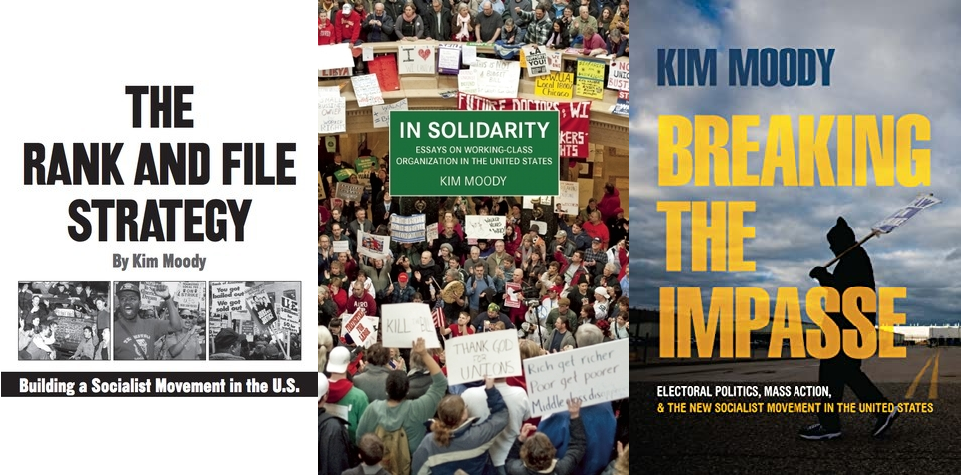
While never achieving the raw book sale numbers of McAlevey or Burns, Kim Moody is somewhat of an elder statesman of the left union movement and has been writing books on the topic since the 1970s. His ideas on unionism that he calls the “rank-and-file strategy” (RFS), introduced in a lengthy pamphlet of the same name in 2000, is probably the most widely debated form of left unionism in the US today. The RFS is a constant reference point for competing visions of unionism within the largest left organization in the US, the Democratic Socialists of America. Moody’s central idea is that we need more socialism in the labor movement, and the RFS is how we achieve that.
Moody was briefly a rank-and-file organizer and then union staff organizer in the 1970s, but has since worked as a professor and has contributed to the labor movement as a left theorist and strategist. His books contain thorough and insightful histories of the labor and socialist movements that can inform how we approach our organizing today.
While I can’t begin to scratch the surface of the lengthy debates around the RFS, we should understand its basic tenets. First, the RFS is explicitly a strategy for how socialists should participate in the labor movement. As the name suggests, the strategy advocates socialists building a presence among the rank-and-file of unions, developing widespread worker class consciousness, and playing a leading role in carrying out worker actions against employers.
Second, Moody identifies union bureaucracy as one of the primary fetters that has been holding the union movement back. The bureaucracy itself will have to be a target of pressure from the rank-and-file alongside employers. So instead of merely capturing higher leadership positions, the RFS seeks to stay rooted in the rank-and-file membership. Moody is, like Burns, uneasy about union staff playing too large a role in unions for fear of worker voices being eclipsed, but, like Burns, Moody still sees an important supplemental role for staff in supporting socialist organizing.
Third, the RFS advocates building class-wide and cross-union left labor formations to facilitate larger coordination, consciousness-raising, and skill sharing. Such formations also seek to obviate the hardening of a provincialism focused only on bread-and-butter issues for already-unionized workers, and rather also seek to confront larger social and political issues and aim to organize the class as a whole. The organization that Moody looks to as the best historical example of this is the Trade Union Education League (TUEL) that was connected to the Communist Party in the US in the 1920s and fostered leftist cross-union strategizing within the mainstream unions of the day. Though unlike TUEL, which Moody criticizes for being too subordinate to the Communist Party, Moody argues that such organizations should seek to be broadly influential and supportive within the labor movement but without trying to take over the unions.
Along these lines, one major project of Moody’s has been Labor Notes, of which he was a co-founder and actively organized with for decades. Alongside its bi-annual conference, which is the largest left labor convergence in the US, Labor Notes produces its own media to advance labor analysis and news and provides trainings around the country. Like McAlevey, Labor Notes puts a lot of useful emphasis on spreading basic union organizing techniques; its book Secrets of a Successful Organizer is probably the most widely read introductory union organizing text in the movement today. Within the RFS, Moody’s hope is that orgs like Labor Notes can provide leftist guidance and coherence to an otherwise scattered and disconnected labor movement.
Lastly, the RFS advocates the idea of the “transitional program,” an idea associated with Trotsky that pairs short-term achievable demands with long-term revolutionary goals. Whereas those like McAlevey see the gulf between short-term demands and long-term goals as too wide to hold together and partly for this reason abandons the long-term revolutionary goals altogether, the transitional program aims to keep the short- and long-term goals in productive tension. One of the aims of such a program is to adjust the rhetoric and aims of union demands to what will gain traction with the rank-and-file given their current state of class consciousness. This means that instead of calling for socialism now, the demands often take a more populist flavor, such as a $15 minimum wage or a shorter work week for the same pay. As the radicalization of the workers advances, the transitional demands and rhetoric is advanced gradually to keep nudging the workers further.
A transitional program thus includes transitional organizations, transitional strategies, and transitional demands. Labor Notes itself is conceived by Moody as a transitional organization, one not advocating the overthrow of capitalism in the now but rather meeting the organizing and political needs of workers who are gradually radicalizing and taking more militant action. The final culmination of such transitional programs is supposed to be a mature socialist working class political party which is able to contest and finally overthrow capitalism.
Moody deserves credit for spelling out this strategy and giving it a historical grounding. If a socialist orientation is Moody’s central idea for strengthening the labor movement, then increasing democracy, militancy, and class consciousness, as detailed in RFS, is the strategy for bringing that socialism into the unions.
While Moody doesn’t support every idea of left unionism out there–he is critical of the staff-heavy emphasis of McAlevey, of the stifling effect of top-down organizational leadership in the Communist Party, and of investing energy in labor-friendly politicians in the Democratic Party, for example–his list of things socialists should be doing is very long and inclusive. The tasks he sets out for the socialist labor movement at the end of his RFS pamphlet includes building cross-union worker orgs, building reform caucuses (discussed more below), fostering international solidarity, setting the foundations for a labor party, and cohering alliances with community groups. In a later update of RFS, Moody added fostering workplace organization (like steward networks) and organizing non-unionized workers into unions to the list. On the positive side, this constitutes a pretty comprehensive program.
On the negative side, this has been, more-or-less, the comprehensive labor program of much of the left for the last 40 years. Just because RFS hasn’t solved all of the labor movement’s problems already is hardly a fair criticism or the standard that we should hold every union theory to. But I do have a nagging feeling that this has all been tried recently without dazzling results, and I fear that Moody’s program amounts to telling socialists to do more of the same.
Rather than make more foundational critiques of the current labor movement that would suggest building new unions outside of and transforming existing unions beyond the NLRB and AFL-CIO framework or taking action beyond what is prescribed by current labor-management relations, the immediate goal seems to be to make the mainstream unions better and then do mostly the same things with them but better. Giving mainstream unions a more rank-and-file focus would doubtless improve them, but would it really push the labor movement out of its historical rut?
Caucus Reformism and the Promise of Enlightened Leadership
Perhaps the main strategy of the labor left over the last fifty years, one which McAlevey, Moody, and Burns all support, is that of socialists running for union officer positions and taking over the formal leadership of unions. Socialists typically form a caucus within the union to pursue this strategy and, once in leadership, aim to reform the union to be more militant, democratic, and leftist. While winning leadership as a caucus isn’t the final goal of caucus reformism, it is the central concept through which all organizing is oriented towards and channeled through.
While leftists winning leadership of unions has certainly captured a large portion of the attention within left labor discourse and has then been used to lead unions to strike, the overall track record of this strategy is debatable. For every success story, like the Caucus Of Rank-and-File Educators within the Chicago Teachers Union (CTU), there are many more lost elections and abandoned caucuses, accumulating like forgotten shipwrecks at the bottom of the sea of labor history.
Even the successes have been more modest and complicated once you take a closer look at them. For example, the authors of Labor Notes’ favorable book on CTU’s famous 2012 strike note honestly how a “big part of their victory was simply holding the line on longstanding aspects of their contract” and that it “was not chock-full of big improvements.” The resulting contract successfully maintained, but did not improve, teacher healthcare benefits and class-size caps. CTU president Karen Lewis, not wanting to sugarcoat the 2012 contract while members were voting on it, said, “This is an austerity contract.” Teachers won an increase in their annual budget for classroom supplies, but that was more than offset by the decrease in benefits that were to be paid out to teachers who were laid off due to school closures. While it was impressive that CTU was able to go on strike at all and not lose given the preceding decades of teacher union decline, it’s important to remember that they didn’t really “win” anything material through the strike either. In subsequent years, CTU and its allies fought but struggled to hold ground against the school closures and charter school takeover which remain an existential threat to public education in the city.
I hardly mean to say that the evidence implies this strategy has failed relative to other left labor approaches but only want to point out that it has not been a clear-cut success either. That this has been the primary strategy of left unionists over the period of the greatest decline in union power isn’t by itself an indictment. But whether this strategy will best facilitate building worker power in the long-term going forward is an open question.
One critique of this strategy is that a focus on winning elections often comes to displace building power on the shop floor by organizing towards direct action. The reform caucus that was active in my union local years ago received plenty of mentorship from and co-hosted speaking events with other big-name caucuses from around the country about how to win union elections. However, rarely did the caucus leaders express interest in organizing with coworkers on the shop floor. While advocates of caucuses will claim that union electoralism and workplace organizing are complementary, I more often see electoral focus on top union offices being pursued at the expense of more grassroots methods.
Another critique is that taking over union structures as they currently exist tends to bind leftists more closely to those formal structures that often are inimical to socialist unionism. Being elected as union president or to an executive board seat increases the danger that a worker will become disconnected from rank-and-file interests and will come to identify with the interests of a layer of union bureaucracy of the kind Moody warns against. Similarly, as Burns warns, union officials are much more subject to the disciplinary power of anti-worker labor laws than union rank-and-file are.
IWW Syndicalism, Dual Unions, and Solidarity Unionism
The union thinkers and strategies noted above are the most prominent being discussed and followed within the left labor movement today. But there are other minor unionisms that are alive and kicking and have at various points in US history been dominant on the left.
The Industrial Workers of the World (IWW) was founded in 1905 in Chicago as an alternative to the mainstream AFL craft unions and to bring together the far flung and diverse radical unionists of the day. From its founding through the mid-1920s the IWW achieved increasing prominence through such big fights as the “Bread and Roses” textile strike in Lawrence, Massachusetts, port-wide strikes among dockworkers and sailors in Philadelphia, and mass organizing of Arizona and Montana copper miners, Pacific NW lumberjacks, and Midwestern agricultural workers. From a peak of an estimated 150,000 members in 1917, the union started to decline sharply in the mid-1920s due to the effects of persistent government repression (in 1918, 101 IWW organizers were convicted on flimsy charges of obstructing the US efforts in WWI and most were sentenced to decades in prison), pro-company thugs killing IWW organizers (like Frank Little and Wesley Everest), internal splits, and competition for members from the ascending Communist Party. By the 1950s only remnants remained and occasional campaigns flickered in and out of existence until a modest resurgence started in the 1990s and continues to this day.
Throughout its history the IWW has been the major US incarnation of a type of radical unionism called syndicalism. In the US IWW, syndicalism has taken the form of “dual unionism” that emphasizes workers building radical unions apart from the mainstream unions. Dual unions thus exist when there are two unions active in the same industry or workplace, which is an organizational approach distinct from either trying to take over leadership of mainstream unions (caucus reformism) or trying to permeate the official positions more broadly in the labor movement (discussed below). Though syndicalists have also sometimes rejected dual unionism and opted to try to take over mainstream unions from below.
A key feature of IWW syndicalism is its opposition to signing contracts with employers (or more specifically, contracts with no-strike clauses). The bargain at the center of capitalist labor relations is that unions give up the right to strike and promise to work as their bosses tell them to for a certain number of years laid out in the union contract. In return the union workers get slightly better wages, benefits, and the boss promises not to bust the union. At the end of each contract, the next contract is fought over and then settled. Syndicalism sees this setup as benefiting the bosses more than the workers, as taking away the right to strike while giving bosses near total control of the workplace is not worth a slight bump in wages and benefits. Also, the boss’s promise to respect the union after signing the contract is rarely kept. Rather, if workers maintain the right to fight and strike for what they think is right and not give up their rights for the majority of their working lives in the form of contracts, they’ll be stronger and be able to win more in the long term. In such avoiding contracts workers can more easily resist labor law and other institutions that bend formal labor relations in favor of the bosses.
Another defining aspect of syndicalism is a more exclusive focus on direct action over legislative, judicial, or electoral methods of change. Rather than seeing either the shift to the left of mainstream parties or the creation of more socialist or worker-focused parties as a primary strategy of working class efforts, syndicalism aims to build power and eventually take over the economy through the efforts of workers themselves through direct action. While some syndicalists, under the banner “anarcho-syndicalism,” have tied their organizing to an explicitly to anarchist politics, the IWW is more open politically (any worker who opposes capitalism can join) even while anarchist principles implicitly play a large role in the IWW’s organizational forms and strategic approaches.
What all of these aspects of syndicalism are tethered to at their core is building worker power in the workplace itself through creating organization on the shopfloor (like workplace organizing committees) and workers taking direct action on the job. This is what leads syndicalism to reject strategies (electoralism) and methods (staff-driven unionism that relies on contracts with heavily bureaucratized grievance processes) that take worker struggle off of the shop floor. The IWW’s methods and ideas are encapsulated in the two-day Organizer Training 101 that it disseminates through its training department and local branches.
As a syndicalist myself, I have fewer personal critiques to make of this form of unionism than the others surveyed here. Common critiques from others on the left, today and in the past, claim that dual unions separate radicals from the masses of workers, that contracts are necessary for consolidating wins in an otherwise chaotic atmosphere of labor relations, and that legislation and elections are battlegrounds too important to ignore. Syndicalists challenge the assumptions and arguments of each of these critiques, but there’s not space to elaborate on them here.
The main challenge for the IWW and American syndicalism since its re-emergence in the 1990s has been to build workplace and industrial presences that are maintained for more than a few years and that have more than a handful of members in more than a single workplace. Like the earlier IWW, the contemporary IWW has often punched far above its weight in the kinds of concessions won and the impacts made in a variety of larger scale efforts (from Starbucks in NYC to Whole Foods in the Bay Area to the Canada Post Office in Alberta to Jimmy Johns in Minneapolis). But for such explicitly syndicalist projects in the US in recent decades, the bigger efforts have flamed out after a short while and the longer-lasting efforts with their own impressive wins have not scaled up. It’s up to syndicalists to prove that their model can become a powerful force in the labor movement in the current era.
Marxist-Leninist Unionism and Permeating the Movement
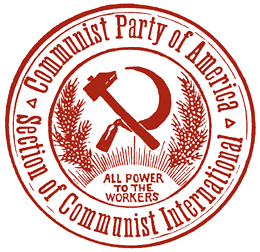
More orthodox Marxist groups are still active in the labor movement, including those who claim Marxism-Leninism (ML), which is identified with the Communist Party USA (CP) in the 1930s and 40s and which today has a number of currents and organizations. The CP was famous for frequently changing its strategic orientation to the US labor movement as Soviet-US relations whiplashed back and forth. But the general strategy of Communists joining labor unions and acquiring official positions at all levels of the labor movement was a consistent part of their approach. This strategy is sometimes called “permeationism” for how the party attempted to permeate its influence and members throughout the labor movement and, by extension, society as a whole. For ML, the central concept is the party, and permeation is the main tool for building party influence through the labor movement.
Permeation reached its peak of influence with the CP’s sprinkling of members throughout the CIO unions in the 1930s, often having clusters of members in key workplaces, in key officer positions of major unions, and in key staff positions. Most famously, CP member Len De Caux became the publicity director of the entire CIO and Lee Pressman, a former CP member who maintained close ties, became its general counsel. The top elected leadership of some of the newly-formed and very successful CIO unions were either dominated by and/or in close alliance with CP members, including the United Farm Equipment Workers, the United Public Workers, the United Electrical Workers, the International Longshore and Warehouse Union, and others. CP members maintained moderate levels of influence in the CIO’s United Auto Workers, Amalgamated Clothing Workers, and the United Packinghouse Workers.
However, CP members at all levels of union officialdom were purged, chased out, or saw their influence greatly constricted with the onset of the Cold War and launch of McCarthy’s witch hunts beginning in the late 1940s. The more liberal leaders of the CIO were all too eager to participate in this red-baiting to consolidate their own power in the unions. This ultimately led the CIO to re-integrate with the AFL in 1955, forming the pole of mainstream unionism which left unionism has sought to shift or provide alternatives to ever since.
Some ML groups take a similar approach today as the Communists did back in the CIO, permeating members into staff and officer positions of important local unions. More than just claiming these positions, MLs also nurture close relationships with key labor officials as a way to gain influence.
Permeation has some features in common with caucus reformism in that both tend to place importance on winning over union leadership. Whereas caucuses tend to be more open about their political alliances and objectives, permeationists often conceal their deeper politics and organizational loyalties. While some CP union officials in the 30s – 50s were open about their party membership, many were not.
ML permeationists today take a similar tack, sometimes being transparent about their politics but often not. Certainly the danger of government purges gave Communists of previous eras more reason to conceal their allegiances, but government purges of Communists in the labor movement is not as immediate a concern today. Both in the past and today, MLs take positions on international politics that are considered very controversial among liberals and other leftists, and not revealing those politics can be useful for not alienating the broader union membership. MLs tend to endorse some version of the vanguard party which sees the working class needing to be led and not being capable on its own of pushing towards revolution. Thus some MLs justify concealing their identity in terms of the masses not being ready yet to be exposed to more revolutionary ideas in their organizations.
Whatever the justification, tensions naturally arise between unions as vehicles of worker power and democracy and unions as targets of permeation whose politics and motives are kept private. In the 1930s and 40s, conflicts frequently broke out among Communists in the labor movement about whether they should follow the latest directive of their Party leaders or ignore directives that go against the wishes and material interests of union members.
One stark example of this was the no-strike pledge that the CIO adopted, with strong CP support, during World War II, which aimed to unite US/USSR and worker/capitalist interests to defeat the Nazis. In actual CIO workplaces, conditions during the war were often bad and bosses knew they could use the patriotic atmosphere and the obedience of the Communists to weaken worker wages and conditions. Wildcat strikes, a kind of strike without official approval and often directed at union leadership as well as the employer, boiled over repeatedly during WWII. Communist rank-and-file organizers played key roles in these wildcats at times. Some Communist labor officials tried to enforce official CP and CIO policy by disciplining the workers to keep them from striking, some sought to give mere lip-service to the no-strike pledge while quietly supporting striking workers, and some completely disobeyed CP policy and threw their lot in with the workers.
While I am critical of MLs’ split allegiances between union members and their secretive party, these split allegiances really plague all forms of left unionism that place a major emphasis on electoral and party alliances. Certainly the mainstream union movement has suffered immeasurably from its close connection to and often subordinate position in relation to centrist Democrats. But also further to the left, for example, recently members of the US Congress who are members of the DSA voted in controversial ways on the recent rail strike conflict, and within the DSA itself there are now calls circulating among members condemning those votes and voicing support for the rail worker demands. While in theory it’s easy to imagine a harmonious integration of left electoral and left labor strategy, in practice it often gets messy and the needs of union members often get put on the back burner.
Relationships and the Meaning of Socialist Unionism
One theory of unionism developed on this blog is what I call “relationship-based organizing” (RBO). It is resonant with some aspects of other unionisms noted above, but what distinguishes RBO is the placing of the coworker relationship itself at the nexus of the web of union concepts.
The other unionisms noted above don’t ignore coworker relationships as a necessary part of organizing, but at the same time coworker relationships are not portrayed as the gravitational center. For McAlevey and Burns, the strike is central, and organizing technique and class struggle demands, respectively, are what make strikes happen. Relationships are further out in the conceptual orbit, which matches with how caucus reformism and permeationism see relationships also. When you read McAlevey, Burns, Moody, and nearly all of the other labor writers and strategists, there’s actually very little discussion about the role of building relationships with coworkers as a part of organizing. To whatever degree relationships do play a role in their theory of change it is mostly assumed.
What is the point of centering the relationships themselves, and what effect does that have on how we see organizing? While collective actions like strikes are how workers exercise power, the source of the power itself is the relationships workers have with each other. Only when workers feel trust, care, and solidarity towards each other are they capable of exercising their power through action. Centering relationships in organizing is a recognition of the nature of worker power as a fundamentally grassroots phenomena. Relationships are then the base upon which every other important aspect of unionism is built.
So RBO turns the world of organizing upside down. Rather than making big strikes the goal and ordering everything according to that, if we make strong relationships the goal then big strikes and whatever other tactics are necessary will come together more naturally. Not only are relationships conceptually primary as an element of worker power, but in most circumstances building relationships should also be the first step of good organizing (this step is strangely absent from nearly all intro organizing materials out there).
If coworker relationships are so essential, why don’t other unionisms highlight them? RBO centers the agency of the workers themselves as the primary doers and protagonists of the union story.
In contrast, most other forms of unionism that have books written about them are written and propagated by specialists, whether academics or journalists or lawyers or professional organizers or higher union officials, who are not themselves the rank-and-file workers. This isn’t to say that these specialists can’t support good grassroots organizing, but their role in doing so is always supplementary. Unfortunately, few specialists truly advance the grassroots in the way RBO aims at in even a supplementary way. Rather, the entire apparatus of mainstream unionism gives authority to these specialists and takes agency out of the hands of the workers themselves.
Most specialists don’t do this intentionally. But once we step back for a moment and really observe who in the labor movement today is calling the shots and crafting the grand unionist visions and planning the big strikes, it’s mostly coming from the specialists and not from the rank-and-file themselves. When these specialists write books or give talks, they’re mostly trying to find “better” ways for the specialists to manage unions instead of placing real power in the workers to run the unions themselves. Some specialists are sincerely trying to manage the unions to make them more democratic and militant, but there’s sharp limits to how much of this can be managed into unions from the outside instead of built by the rank-and-file themselves from the inside.
And most of the time, this isn’t the fault of the specialists themselves, as the whole structure of the labor movement aims to elevate the specialists to the role of managers of the labor movement. Forces pushing in this direction include severely restrictive federal and state labor laws, the near-universal presence of no-strike and management rights clauses in today’s union contracts, employers building schmoozy relations with union officials in order to pacify and co-opt them, national and international union structures that are insulated from member influence, mainstream unions’ close ties to the Democrats as a capitalist political party, and a liberal popular culture that tends towards hero-worship and towards distrust of grassroots agency.
No matter who’s responsible for this mess, the way out of it is for workers to take back the agency themselves. They do this, first and foremost, by building relationships with each other that they have ownership of themselves and which can’t be captured by some outsider.
The IWW and Labor Notes are two of the union tendencies surveyed here that are most uneasy with specialists. Not coincidentally, the IWW and Labor Notes are the two tendencies that pay more than just lip-service to the role of relationships in organizing. Still, I see many within IWW and Labor Notes circles getting caught up in the purely technical aspects of organizing and creating a sense of urgency that undercuts the relational focus. I want to see what happens when the relational focus is pushed further, much further even.
I’ve come to RBO, alongside others I organize closely with, through our own practical and collective organizing experience. We’ve discovered that the most common obstacle to organizing around this or that problem at work is that the relationships between coworkers are not strong enough. There’s not enough mutual trust, care, and solidarity to openly discuss grievances or to bear the risks of taking collective action to resolve them. Maybe one side of the relationship is strong, such as all the coworkers agree politically or bond closely outside of work in social settings. But for coworkers to be strong enough to really push back on the boss and flip the balance of power through direct action, the relationships themselves have to not only be strong but also contain all of the necessary dimensions. Whatever the problem, stronger and more well-rounded relationships between coworkers is usually a main part of the solution.
Well-meaning and eager organizers often don’t recognize this and instead turn to some other aspect of organizing to solve problems, such as the technical details of organizing conversations or structures tests, radical rhetoric delivered in a fiery tone, or a dependence on specialists to fix things and tell them what to do. Often these approaches miss the mark because they are implemented while ignoring the relational base.
Through reading their books I’ve learned a lot from McAlevey, Burns, Moody, and others. In critiquing them and advocating RBO, I don’t mean to discard all their ideas. Rather, I’ve found that some of the organizing ideas and practices discussed by those authors become most useful when I am able to reinterpret them within a relationship-based framework. Strikes, radical demands, and grassroots democracy all become a more robust part of worker power when they are not just awkwardly imposed upon coworker relationships from above but rather are built up through relationships from below. Much of the writing on this blog is an attempt to reframe organizing techniques and radical ideas in precisely this way.
Conclusion
No union tradition or text is holy writ. Rather, for the labor movement to really be resurrected as something that capital fears, the workers themselves will have to critically engage existing practices and then formulate new and more powerful methods of unionism.
Some of the prominent labor authors today used to be rank-and-file organizers long ago, but many never were. What happens when the main stories of the labor movement are told about and through the lens of leaders and specialists who are not themselves rank-and-file? The effect of this is that those workers who get really interested in and motivated to build the labor movement think they have to leave their coworkers behind to do so. They think they have to go run for higher union or government office or apply for staff positions or go to law school. Many of our most committed and passionate unionists then leave the workplaces where organizing is happening instead of becoming more deeply rooted in them. This is the predictable but no less self-destructive result of kinds of unionism that de-emphasize the importance of relationships between workers as the source of our power.
Whatever kind of labor movement that is, it’s hardly one that earns the label of socialist, one where workers are truly at the helm. The vast majority of the militant union upsurges of the past were not led by union presidents or specialists, but were led by a grassroots layer of rank-and-file radicals. At times the union leadership of groups like the CIO went along with and pretended to lead these upsurges, but their participation in the upsurges was nearly always the effect of grassroots militancy and rarely its cause.
Rather than looking up to big-shot labor commentators or union presidents for guidance, workers will do better if they look around their workplaces and discover the potential power of the community of relationships on the job that they’re already a part of. It can be a little terrifying to really believe in people. People can and will disappoint you. We’re not at this moment capable of what we truly need to do.
But with some effort, workers can start to trust one another, build everyone up, and make ourselves into a movement. When these processes get going, when that enormous mass of human activity called the working class begins to assert itself, when the ground begins to shake, who will we become? Will we lament that if only we had had a better leader maybe we wouldn’t have lost? Or will we be able to tell the next generation that the workers really did accomplish the impossible, that history extended its hand to us and we grasped it, that we fought alongside heroes, that all we started with was each other?
 Fire with Fire
As a counselor, I couldn’t agree more with RBO. I want to know more. As a volunteer organizer and steward who has attended Labor Notes and am a former Wobbly, I want techniques I can use. May I humbly recommend Motivational Interviewing, by Miller and Rollnick as a counseling basis for building motivational relationships and conversations? It needs a cliff notes version targeting the Union Relationship which is unique among relations in this world. Maybe secrets of a successful organizer comes close.
My questions are what do I do about the right wing die hard individualist, the snitch, the mentally ill, the competitive, the loudmouth, the know it all, and the clingy workers? How do we navigate the risk of becoming embroiled in the dysfunctions of the working class to reap the reward ofsolidarity?
Another home run article!
LikeLiked by 1 person
Thanks, and I’ll take a look at the Millner and Rollnick! I feel like I’m constantly stealing good ideas for my organizing and writing from therapy and psychologists.
As you also point out, a frequent challenge I hear from people is how to deal with difficult coworkers, which is something I’ve largely side-stepped so far with RBO but hope to write about it sometime soon.
LikeLike
Wow, yes, tell me more about RBO! Like the commenter above, I’m also in healthcare (was a mental health provider for close to a decade), union steward, and Labor Notes regular, and the RBO approach resonates deeply with me. I’d love to learn more and to find materials that focus more on the relational aspects of organizing.
I second the commenter above in that motivational interviewing is definitely something organizers should be familiar with because it’s focused on building autonomy-respecting relationships with people and helping them resolve ambivalence and take committed action toward ends they care about. I have not seen any organizing training materials that mention MI – as someone who came to organizing from healthcare and not the other way around, the ‘organizing conversation’ was easy to understand because it reminded me so much of MI.
Excited to dig into other writing on your blog!
LikeLiked by 1 person
Well you’ve come to the right place! I don’t know many other places that talk explicitly about the relationship side of organizing, but it’s a way of thinking that my fellow organizers and I have experimented with and developed. If you want to share, as you read more I’d be curious what about it resonates or feels relevant to your experiences and ideas.
LikeLike
I loved this article – I’m an organizer of a premajority union in the south and I’m leaning on a lot of movement organizing techniques that center relationships rather than traditional labor practices. But I like the militancy of union organizing. I feel like each tradition has a lot to learn from each other. I’d love to chat more about how you’ve explored these principles in practice – what has worked and what hasn’t?
LikeLiked by 1 person
Hi Claire! Sorry for the slow response, I had a lot going on but now things have settled down and I’d be happy to chat more on here. I should say that all of the above strategies I discuss “work” in the simple sense, and all of the writers and orgs that use them have a history of some degree of success with them. If a group of organizers takes any of the above methods and applies them skillfully and faithfully, I think they can make them work too.
To me, the question is rather, “What works for building the kind of union you want to build?” If you look at the kind of unions where McAlevey, Burns, or Moody’s ideas have been made to work, and that kind of union is the union you want to build, then using their ideas will get you there.
I personally have been developing a critique of hierarchy and paid staff in organizing. All of the thinkers above share this critique to some degree, but I find myself going farther and farther in that direction, to the point where I reject some of the core assumptions of McAlevey, Burns, and Moody (some of this critique is discussed above, some of it can be found in other posts on my blog, some of it I have yet to write about).
So what works for building the kind of unions I want is not going to be the same as those other thinkers, though I will freely borrow various smaller ideas and theories from those thinkers as I find them useful.
Of course, each of these thinkers tends to frame their ideas as the “right ideas” instead of just the “right ideas to build this specific kind of union.” So to really evaluate these different methods and determine what’s best for you, I think you have to take a step back and look more deeply into what kinds of unions result from the methods being advocated by these thinkers. My purpose in providing a survey of these ideas is partly to help people figure this out for themselves. Though clearly, above I just give a brief summary of the ideas of each thinker, and if you want to further investigate whether some thinker’s ideas are useful to build the kind of union you want, you’ll have to go read their works for yourself. I hope the above summary helps people navigate this.
Do you know what kind of union you want to build? What does that look like for you?
LikeLike